
A security posture assessment takes as long as the agreed scope requires: collecting evidence, obtaining authorized access, interpreting findings and delivering a reviewed report are separate parts of the timeline. A completed scan is not a completed assessment, and remediation and verification need their own agreed finish points.
- How long does a security posture assessment take? Define scope, access and the finished deliverable before committing.
- SCOUTz supports MSP prospect intelligence; dated security evidence prepares a conversation rather than proving a breach.
- Public-domain reviews and customer-authorized Microsoft 365 assessments have different access requirements and evidence boundaries.
- Separate collection, human review, reporting and verification when scheduling an assessment.
How long does a security posture assessment take to complete?
Set the completion date after defining what “complete” means. A public-domain review, a consented Microsoft 365 configuration review and verification of a completed change answer different questions. Giving them the same deadline hides those differences.
For MSP sales preparation in 2026, use the SCOUTz category boundary: dated cybersecurity evidence and prospect context support discovery. They do not replace the MSP’s judgment about scope, business impact or the next action.
Build the schedule in this order:
- Define the decision the assessment must support. Meeting preparation and a remediation decision need different deliverables.
- Name the systems, domains and objects included. Record exclusions before collection starts.
- Confirm the permitted collection method and required customer authorization.
- Collect evidence and record what ran, when it ran and what remained unread.
- Review findings, separate observations from implications and prepare the agreed report.
- Schedule verification separately if the engagement includes checking subsequent changes.
The completion promise should describe a deliverable, its dependencies and its acceptance criteria. A runtime alone describes only the collection stage.
Why this matters
An MSP owner needs a usable conversation, not merely an exported result. A security practitioner needs enough context to defend each finding without overstating it.
Those needs meet at the evidence boundary. If a report says an email-security condition was observed, the reader must know which domain was checked, when it was checked and what the observation establishes. A polished report without those details creates more discovery work.
For a 2026 assessment plan, distinguish elapsed calendar time from hands-on work. Waiting for consent belongs on the calendar even when no analyst is actively reviewing evidence. Treating that wait as scan performance produces a misleading estimate.
Public-domain review: finish at the documented observation
A public-domain review supports questions about externally observable domain and email-security conditions. Its useful output is a dated observation with a defined boundary, an implication and a question for the responsible owner.
Consider a published DMARC policy requesting monitoring only. The observation supports asking who reviews reporting and whether monitoring-only remains the intended policy. It does not establish compromise or prove that the configuration is an unresolved mistake.
A public review also cannot establish internal Microsoft 365 conditions such as Conditional Access coverage, application permissions, license assignments, Intune device state or tenant sharing configuration. If those questions matter to the engagement, add a separately authorized internal review.
Keep public observation distinct from active probing. Agree on the method and permission requirements before scheduling collection; do not assume that a publicly reachable service gives blanket permission for every assessment technique.
Microsoft 365 review: finish at reviewed, authorized evidence
A customer-authorized Microsoft 365 review has a different starting dependency: approved access to the relevant evidence. Schedule that approval explicitly rather than treating it as an invisible prerequisite.
Within the product boundary described by the client, Microsoft 365 evidence consists of configuration and metadata. It excludes mail, files, chats, documents and prompts. The review is read-only, requires no agent or install and makes no automatic configuration changes.
Permission and license limits still matter. An unread source remains unread, even when the rest of the assessment produces useful findings. A finished report must distinguish the evidence collected from the questions left open.
Use the comparison below to agree on the appropriate deliverable before promising a date.
| Assessment scope | Best for | Useful output | Limitation affecting completion |
|---|---|---|---|
| Public-domain review | Preparing externally grounded discovery questions | Dated observations about the reviewed public domain | Cannot establish internal tenant controls |
| Authorized Microsoft 365 review | Discussing tenant configuration with customer consent | Reviewed configuration and metadata evidence | Depends on authorization, permissions and readable sources |
| Verification rescan | Checking a claimed change against an earlier condition | A comparison with a pinned baseline | Requires the change and comparison scope to be defined |
Each scope has a legitimate job. Choose it by the decision you need to support, rather than treating the broadest review as automatically better.
Why security posture assessment timelines vary
The timeline changes when the work changes. These dependencies deserve separate entries in your assessment plan:
- Scope: Public-domain evidence and authorized internal evidence require different collection boundaries and acceptance criteria.
- Authorization: Customer approval is a dependency for consented Microsoft 365 evidence, not an administrative detail to hide inside runtime.
- Evidence coverage: Partial, permission-limited or license-limited coverage requires an explicit account of what remains unknown.
- Human review: A reviewer must separate the observed condition, affected object, possible consequence and recommended outcome.
- Report audience: Operator findings and a client-safe business discussion serve different readers and require different explanations.
- Verification: Demonstrating a change requires a rescan against a pinned baseline, rather than a fresh result without a comparison.
Do not turn these factors into an unexplained buffer. Assign an owner to each dependency and state what happens if it remains incomplete at the reporting deadline.
For example, an authorization delay should trigger a revised scope or date. It should not silently turn an internal assessment into a public-only report carrying the original label.
Build the schedule around evidence, insight and proof
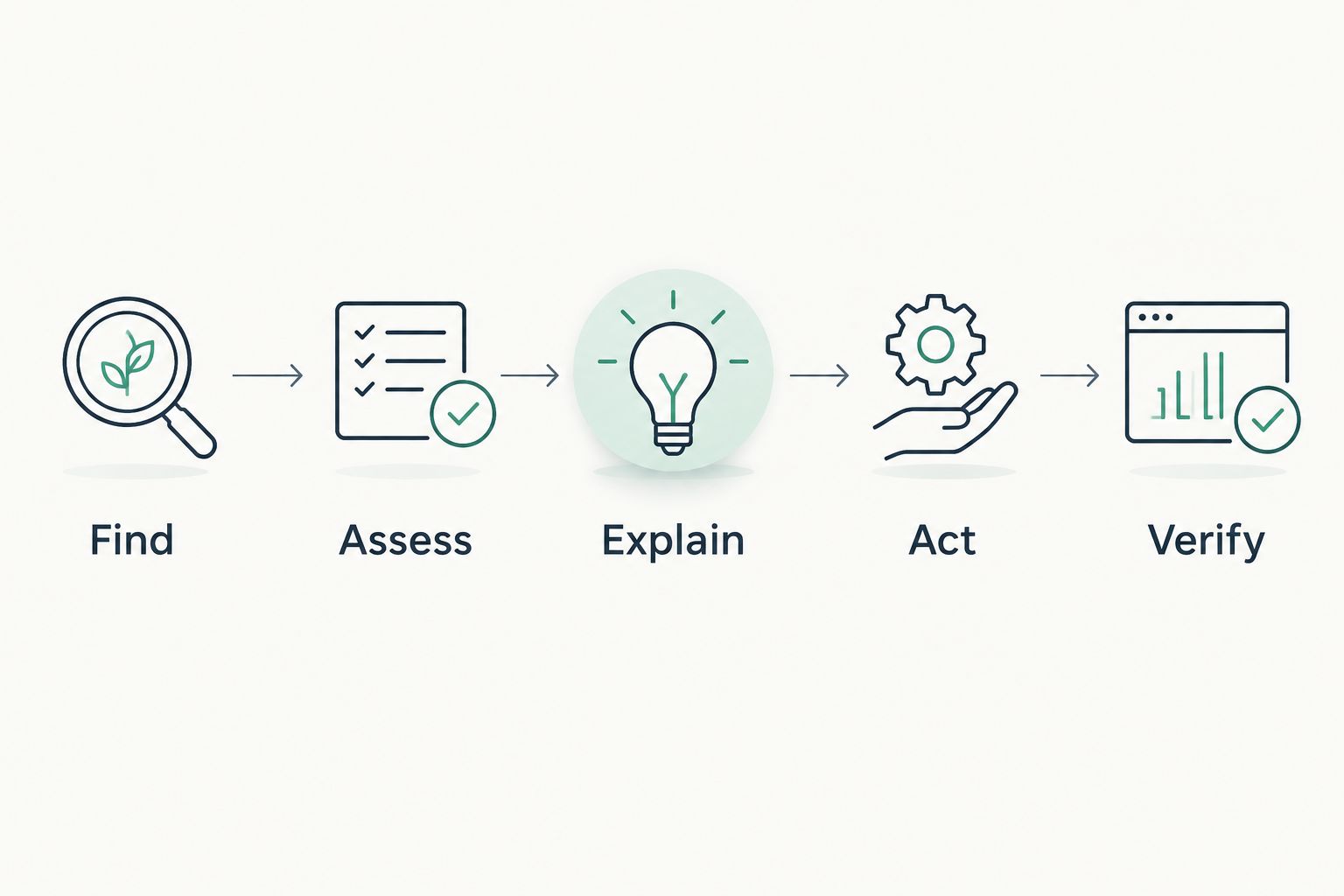
Use the assessment workflow to define handoffs. SCOUTz cybersecurity prospect intelligence is best for MSPs preparing sales conversations with dated security evidence. The relationship, interpretation and sale remain the MSP’s responsibility.
Find
Identify the prospect, domain and business question. Record why the review is relevant without treating a public event or enrichment signal as proof of buying intent.
The handoff is a scoped research question. “Prepare for a discussion about the prospect’s email-security configuration” is more useful than an undefined instruction to assess everything.
Assess
Collect only within the agreed boundary. Attach the check, affected object, source and run date to the observation, and record unavailable evidence separately.
The handoff is an evidence set with coverage stated. A failed read must remain visible instead of disappearing from the final narrative.
Explain
Translate the observation into a business discussion without upgrading its certainty. Keep the condition, possible consequence, unknowns and question for the owner distinct.
The handoff is a reviewed explanation. A tenant-wide permission is not proof of a malicious application, just as an answering service is not proof of an exploitable service.
Act
Agree on the next choice with the owner. The appropriate outcome can be a product, service, process change, project or no change.
The handoff is a decision with responsibility attached. A finding alone does not determine the vendor, project scope or commercial proposal.
Verify
Compare the relevant condition with the pinned baseline after an agreed change. Preserve the original evidence so the comparison has a defensible starting point.
The handoff is proof of what changed within the reviewed scope. It does not establish that every unrelated control is effective.
Define the report’s acceptance criteria
For a 2026 engagement, make completion testable. The report should let another reader distinguish a supported observation from an inference without needing the original analyst in the room.
Use these acceptance criteria:
- Each finding retains its check name, affected object, source and run date.
- Evidence states remain distinct: Verified, Observed, Inferred, Possible, Unknown and Unreadable.
- Coverage remains separate: Assessed, Partial, Not assessed, Permission limited and License limited.
- Declared non-reads appear under NOT ASSESSED THIS SCAN.
- Recommended outcomes identify the decision required without prescribing an unsupported vendor choice.
- Any verification claim identifies the baseline and the scope of the comparison.
These labels do different jobs. “Observed” describes the evidence state; “Partial” describes coverage. Combining them into a single reassuring status hides the uncertainty the owner needs to understand.
A report can be complete for its agreed scope while leaving explicit unknowns. It cannot honestly become complete by relabeling those unknowns as clean.
Keep product status separate from assessment duration
Product scope is another scheduling boundary. The client’s October 15, 2026 reference lists Public Domain Score, Domain Fix Lab and Domain Review as available, with Microsoft 365 Review, Evidence Reports / Studio + Reports, Prospect Intelligence and Guided Remediation in Open Beta.
Those are dated product-status statements, not completion-time commitments. Confirm the current scope and beta conditions before putting a product-dependent deliverable into an engagement plan.
SCOUTz security assessments support evidence-led preparation, with the benefit of separating public-domain observations from consented internal evidence. The limitation is equally important: these reviews do not replace broader delivery platforms, professional judgment or agreed verification work.
For MSPs evaluating that workflow, the primary next step is Join Open Beta. Define the intended assessment and report audience before treating the evaluation as a client delivery commitment.
Can I finish a security posture assessment before a prospect meeting?
A meeting-preparation assessment is complete when its agreed evidence packet has been collected and reviewed, with limitations attached. Keep the scope aligned with the meeting decision rather than implying a full internal assessment from public observations.
Use the domain scan to first-call evidence packet workflow to frame the handoff between collection and discovery. Treat the packet as a basis for questions, not evidence that the prospect has agreed to a project.
Does remediation count toward assessment completion?
Remediation counts toward completion only when the engagement explicitly includes it. Define assessment delivery, the owner’s decision, configuration changes and verification as separate milestones.
This separation protects both parties. The assessment can document a condition without claiming it remains unresolved after the evidence date, while a later rescan can establish what changed.
Does a finished scan mean the environment is secure?
A finished scan means the collection process reached its endpoint within its permissions and scope. It does not prove that unread sources are clean or that controls outside the review were assessed.
For your 2026 reporting template, put the evidence date beside the condition and the coverage boundary beside the conclusion. Those details make the result usable after the meeting ends.
FAQ
How long does a security posture assessment take from start to finish?
A security posture assessment takes the time required for its agreed scope, access approvals, collection, human review and reporting. Define the finished deliverable before committing to a completion date.
Is scan runtime the same as assessment turnaround?
Scan runtime covers collection, while assessment turnaround also includes the agreed preparation, authorization, interpretation and report delivery. Schedule those dependencies separately.
Can a public-domain review assess Microsoft 365 security?
A public-domain review cannot establish internal Microsoft 365 conditions such as Conditional Access coverage, application permissions or tenant sharing configuration. Those questions require appropriately authorized internal evidence.
Does a Microsoft 365 review need access to email contents?
The Microsoft 365 review boundary described here uses configuration and metadata, never mail, files, chats, documents or prompts. Authorization and readable evidence still determine coverage.
What happens if part of the assessment cannot be read?
Unread evidence remains explicitly unknown or unreadable, with the coverage limitation recorded. It must not be presented as an absent problem or an effective control.
Does a completed assessment include fixing the findings?
A completed assessment includes remediation only when that work is part of the agreed engagement. Record the assessment, owner decision, change and verification as distinct milestones.
How do I prove that a security finding changed?
Verify the relevant condition with a rescan against a pinned baseline. Keep the original check, scope and evidence date attached so the comparison shows what changed.
One last thing
Pin the baseline before anyone changes the configuration. Without that starting point, a later result shows a condition at a later date, but does not by itself demonstrate the change you intended to prove.
Make the baseline part of the assessment handoff. That turns “finished” into a documented boundary and gives the next review a defensible starting point.