
Yes. MSPs can assess public-facing domain and email-security evidence without accessing a client's internal network, and they can review Microsoft 365 configuration through customer-authorized read-only access without a network connection. The boundary matters: neither approach establishes the condition of internal devices, network segmentation, backups or controls outside the review's actual scope.
- Can MSPs run a security assessment without accessing a client's network? Yes, within a clearly stated evidence scope.
- Public-domain reviews establish external observations; Microsoft 365 configuration reviews require customer authorization.
- SCOUTz fits MSP prospect preparation with dated cybersecurity evidence; the MSP owns interpretation and the next conversation.
- Unknown and unreadable evidence must remain visible. Neither state establishes that a control is working.
Can MSPs run a security assessment without accessing a client's network?
Yes, but the assessment must name the evidence it can actually reach. Public-domain observation, authorized cloud review and internal network assessment answer different questions. Treating them as interchangeable creates claims your evidence cannot support.
Start with the domain security scanning tools for MSPs guide when your immediate task is prospect research rather than internal infrastructure testing.
| Review approach | Best for | Evidence available | Main limitation |
|---|---|---|---|
| Public-domain review | Preparing an initial conversation | Public DNS and externally observable domain or email-security conditions | Cannot establish internal network or tenant configuration |
| Customer-authorized Microsoft 365 review | Discussing tenant configuration with consent | Configuration and metadata available through approved read-only permissions | Findings depend on permissions, licensing and readable sources |
| Internal network assessment | Examining internal infrastructure | Evidence from authorized internal systems and network access | Requires a separately agreed access method and scope |
The advantage of an external review is its narrow starting point. Its limitation is the same narrow scope. A cloud review adds internal tenant evidence, but it still does not become an assessment of every endpoint, application or network control.
Why this matters
For an MSP preparing a prospect meeting in 2026, the useful output is a defensible starting point for discovery. A report should distinguish an observed condition from its possible consequence, then identify what the client needs to confirm.
A published DMARC policy requesting monitoring is an observable condition. It does not establish compromise, prove that an email attack succeeded or establish that the organization has an unresolved problem. The intended policy, reporting process and accountable owner still need discussion.
That distinction changes the sales conversation. You arrive with evidence and a bounded question instead of asking the prospect to accept an unsupported diagnosis.
Public-domain reviews: external evidence with a narrow boundary
A public-domain review can examine information published outside the client's network. DNS-based email-security records are a useful example: they provide evidence about published policy without requiring access to mailboxes or internal devices.
Keep the finding attached to its source and collection date. An observation describes what the review found at that time; it does not establish what was configured before collection or what remains configured afterward.
For a monitoring-only DMARC observation, use this structure:
- Observed: the published DMARC policy requests monitoring rather than enforcement.
- Possible consequence: the published policy does not request quarantine or rejection through DMARC enforcement.
- Boundary: the DNS record alone does not establish message outcomes, report review or compromise.
- Owner: identify who manages the domain and reviews authentication reports.
- Ask: confirm whether monitoring remains intentional and whether further review is wanted.
Recommend a public-domain review for initial evidence gathering, not tenant assurance. Public observations cannot establish Conditional Access coverage, application permissions, license assignments, Intune device state or tenant sharing configuration.
An answering service is another boundary to preserve. A service answering a request does not establish that the service is exploitable. Keep the observation separate from any vulnerability claim.
Microsoft 365 reviews: consented evidence without network entry
A Microsoft 365 review can examine authorized tenant configuration without connecting to the client's internal network. The access boundary moves to the cloud tenant, where customer consent and the granted permissions determine what the review can read.
Network access and authorization are separate questions. A review that requires no internal network connection still requires authorization for nonpublic tenant evidence.
For a 2026 Microsoft 365 assessment, state the approved scope before discussing findings. Record the tenant, source, run date, permission boundary and any license-dependent limitations alongside the result.
The review described here is read-only. It requires no agent or installation, makes no automatic configuration changes, and reads configuration and metadata rather than mail, files, chats, documents or prompts.
Recommend a customer-authorized cloud review when the question concerns tenant configuration. Its benefit is evidence unavailable from public DNS. Its limitation is that permission restrictions, licensing and unread sources can leave important questions unanswered.
A tenant-wide application permission does not establish that an application is malicious. Describe the permission, affected application and review question separately from the proposed action.
Why assessment coverage varies
Coverage depends on the evidence boundary, not the confidence of the report's wording. These factors determine what an MSP can responsibly conclude:
- Source scope: public-domain observations and customer-authorized tenant evidence expose different conditions.
- Granted permissions: read-only authorization determines which tenant sources the review can inspect.
- License coverage: some evidence depends on the customer's licensed capabilities.
- Readability: a source that cannot be read leaves an evidence gap.
- Collection date: a dated observation does not establish the current condition indefinitely.
- Assessment objective: meeting preparation, tenant review and internal infrastructure assessment require different evidence.
Record these limits beside the affected finding. A generic disclaimer at the end of a report does not explain which specific conclusions remain unsupported.
For 2026 reporting, keep platforms separate. Combining public-domain and tenant results into one score obscures which sources were assessed and which questions still require access.
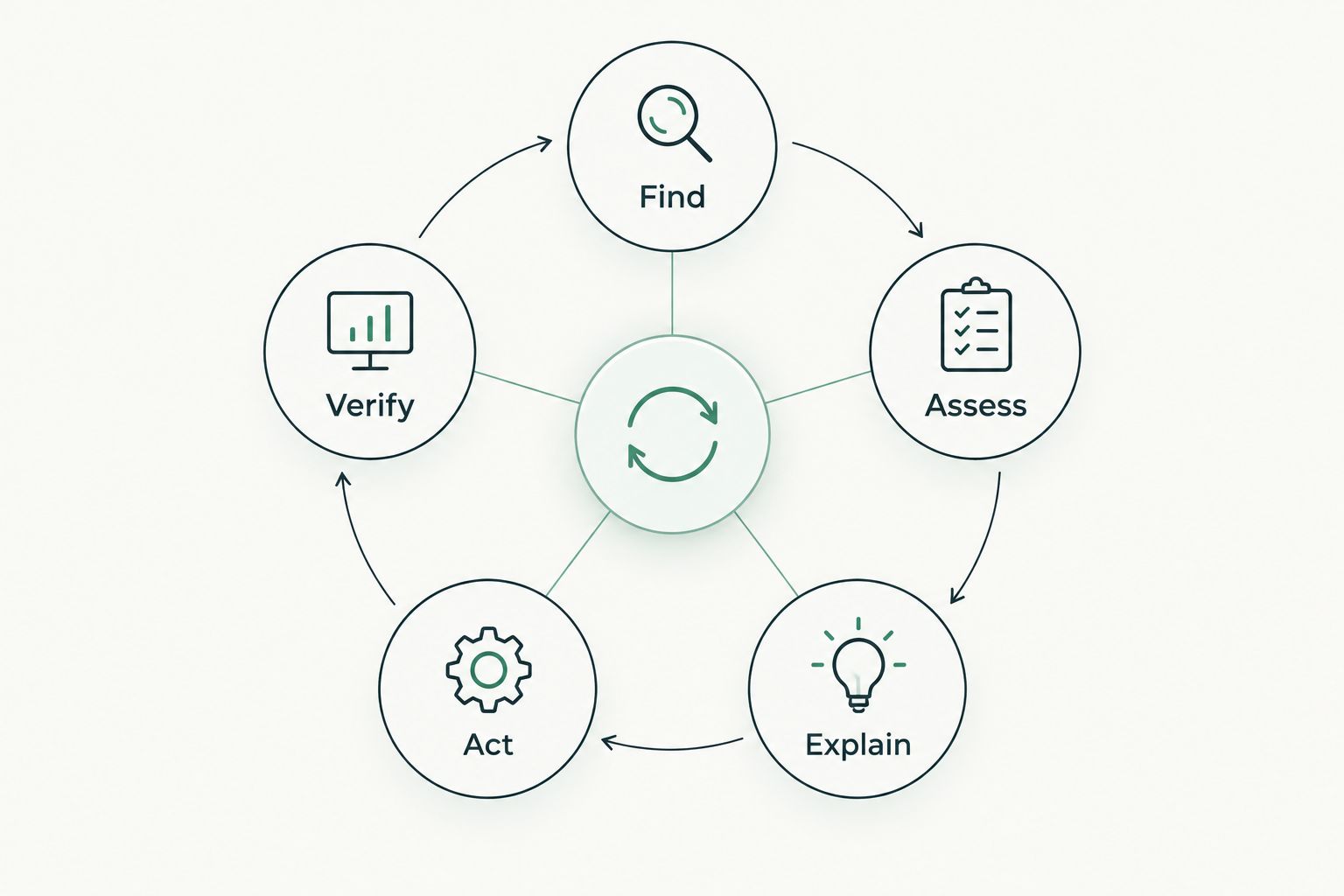
Build the assessment around evidence, insight and proof
Use a repeatable sequence so the meeting stays connected to what ran, why the observation matters and what later changed. The client's decision remains separate from the tool's finding.
Find
Identify the organization, relevant domain and purpose of the review. Confirm that the domain belongs to the intended account before attaching evidence to a prospect record.
Keep public events and third-party enrichment in their proper role: research context. They do not establish buying intent or prove that the organization wants an assessment.
Assess
Collect only the evidence covered by the agreed scope. Separate public observations from customer-authorized Microsoft 365 reads, and retain the check name and run date with each finding.
Declare sources that were not read under NOT ASSESSED THIS SCAN. Do not convert an incomplete collection into a clean result.
Explain
State the condition, affected object and possible consequence. Then name the boundary and the question that would resolve the uncertainty.
Use this stage to prepare discovery, rather than to select a vendor prematurely. A technical observation does not decide whether the appropriate response is a product, service, process, project or no change.
Act
Ask the accountable owner to choose the next step. That choice can be further authorized review, confirmation of an intentional configuration, a scoped change or acceptance of the present condition.
Offer outreach scans as opt-in courtesies after a reply. Distinguish public observation from active probing, and obtain appropriate authorization for the proposed activity.
Verify
Rescan against a pinned baseline to establish what changed. Preserve the original observation and the later result so the report shows evidence of change rather than simply displaying a different score.
These 5 workflow stages support the same discipline in a prospect meeting, proposal or QBR. Each stage has a different job; none substitutes for the client's decision.
Keep evidence state separate from assessment coverage
A finding's evidence state describes the claim. Coverage describes the reach of the review. Mixing the two makes an unread source look like a security conclusion.
Preserve these 6 evidence states: Verified, Observed, Inferred, Possible, Unknown and Unreadable. They are distinct labels, not a linear score ladder. An inference must remain identifiable as an inference even when it supports a useful discovery question.
Preserve these 5 coverage labels separately: Assessed, Partial, Not assessed, Permission limited and License limited. Coverage explains where the review stopped and why.
For a 2026 client-safe report, put both concepts beside the affected object. A reviewer should be able to see what was observed, which source supports it, when collection occurred and what remains unknown without reconstructing the assessment from footnotes.
Unread evidence is unknown, not clean. The absence of a readable result does not establish the absence of a control or a problem.
What should the MSP bring to the prospect meeting?
Bring a short evidence packet that makes the next conversation specific. Keep the technical details available, but lead with the condition and the decision it supports.
Include the following information for each material observation:
- The affected domain, tenant or object.
- The check name, source and run date.
- The observed condition and evidence state.
- The assessment coverage and declared non-reads.
- The possible consequence, separated from confirmed facts.
- The accountable owner and a bounded next choice.
In a proposal, keep the recommended outcome separate from the vendor choice. For example, clarifying the intended DMARC policy and report ownership is a discovery outcome; selecting a particular service is a later decision.
Do the same in a QBR. Backup software presence establishes presence only. Recoverability requires evidence appropriate to that separate claim.
Where SCOUTz fits
SCOUTz is best for MSP owners and sales leaders preparing prospect conversations with dated cybersecurity evidence. Its role is cybersecurity prospect intelligence: account context and evidence an MSP brings into discovery.
The client-supplied October 15, 2026 product reference lists Domain Review as available and Microsoft 365 Review as Open Beta. Treat those as dated product-status references, rather than evidence that every source or workflow is available in every review.
SCOUTz prepares the conversation; the relationship and the sale stay yours. Its evidence does not replace MSP judgment, establish buying intent or guarantee a sales outcome.
For MSPs evaluating SCOUTz, Join Open Beta is the primary next step. Confirm the current scope and participation terms through SCOUTz before planning a customer-facing workflow.
Can an external assessment prove a client is secure?
An external assessment cannot prove that a client is secure. It supports specific claims about the sources and conditions actually assessed, while internal infrastructure and unread tenant evidence remain outside that conclusion.
Use the result to define the next authorized question. Avoid turning limited visibility into organization-wide assurance.
Does read-only access remove the need for client consent?
Read-only access does not remove the need for client consent. It limits what the review can do after authorization; the client still needs to understand the scope, permissions and evidence collected.
Keep consented internal evidence separate from public-domain observations in both the report and the sales conversation.
FAQ
Can an MSP assess security without installing an agent?
Yes, a public-domain review or customer-authorized read-only cloud review can operate without an agent. That does not establish the condition of internal endpoints or every network control.
Does a public-domain scan show Microsoft 365 Conditional Access coverage?
No, public-domain evidence cannot establish Conditional Access coverage. That question requires customer-authorized tenant evidence with appropriate scope and readable sources.
Does a monitoring-only DMARC policy mean the client was breached?
No, a monitoring-only DMARC policy does not establish a breach. Report the published policy, its collection date and the question of whether that policy remains intentional.
What should an MSP report when a source cannot be read?
Report the source as unreadable or unknown and state the coverage limitation. Declared non-reads belong under NOT ASSESSED THIS SCAN rather than being treated as clean results.
Is a Microsoft 365 review the same as a network vulnerability assessment?
No, a Microsoft 365 review examines authorized tenant evidence, while a network vulnerability assessment addresses a different scope. Select the assessment based on the question the client needs answered.
Can an MSP scan any prospect without permission?
There is no blanket authorization to scan any prospect. Distinguish public observation from active probing, confirm the applicable requirements and offer outreach scans as opt-in courtesies after a reply.
How does an MSP prove a security condition changed?
An MSP can compare a rescan against a pinned baseline. Keep the original check, source and run date attached so the comparison supports a specific claim about change.
One last thing
A narrower claim can make a more useful meeting. Before sending a 2026 assessment, identify every sentence that implies compromise, buying intent or an unresolved problem, then check whether the attached evidence supports that exact claim.
If it does not, turn the sentence into a bounded question. The report should help the client make a decision, not force the evidence to carry a conclusion it cannot support.