
Manufacturing-client security posture assessment is a scoped review of cybersecurity evidence aimed at identifying decisions that protect production continuity and business access. For MSPs, a security posture assessment for manufacturing clients must separate public-domain observations, customer-authorized Microsoft 365 evidence, and operational technology questions that require their own assessment.
- A security posture assessment for manufacturing clients needs separate scopes for public domains, Microsoft 365, and operational technology.
- SCOUTz supports MSP sales preparation with dated domain and Microsoft 365 evidence, not a complete factory assessment.
- Record the source, collection date, and limits before turning a finding into a recommendation.
- Treat unread evidence as unknown, and confirm current conditions before proposing remediation.
Why security posture assessment matters for manufacturing clients
Manufacturing assessment starts with a business constraint: security work must respect production operations. An MSP needs to establish which systems support office work, which support production, and who can authorize investigation or changes. A domain review cannot answer those questions alone.
Your first meeting in 2026 should establish the assessment boundary, not announce a factory-wide security verdict. Email authentication evidence can support an email-security discussion. It cannot establish whether a production network is segmented, a recovery procedure works, or a machine vendor retains remote access.
For prospect preparation, compare MSP prospecting tools by the evidence they provide and the limits they disclose. A contact record answers who to approach; a dated security observation helps you decide what to ask. Neither establishes buying intent.
The useful output is a defensible next decision, not the largest possible findings list. Keep technical evidence precise enough for a practitioner and its consequence clear enough for the owner.
How to assess a manufacturing client's security posture
Define the assessment boundary
Start manually with a scope document and an interview. Ask the manufacturing client to identify the business services under review, their owners, and any production dependencies. Do not infer the plant environment from a company website or email domain.
Use 2 assessment tracks as a planning rule: business IT and operational technology. A shared identity or support process can connect those tracks, but a connection must be established through authorized evidence. Shared branding is not proof of shared infrastructure.
For a 2026 assessment, record exclusions as clearly as inclusions. A Microsoft 365 review should not silently become a claim about controllers, production workstations, industrial networks, or equipment maintenance access. Agree on authorization before collection begins.
Close the scope discussion with these actions:
- Name the business services and domains included in the review.
- Identify the tenant owner and the production-system owner.
- Separate observation permissions from change permissions.
- Document excluded systems and prohibited testing methods.
- Assign a person who can resolve scope questions.
Collect public-domain evidence
Begin with public records and a dated worksheet. Review the client's confirmed domains and the email-authentication records relevant to the agreed scope. SPF, DKIM, and DMARC address different parts of email authentication; do not collapse them into a single clean-or-unsafe label.
A published DMARC policy describes handling requested for messages that fail DMARC checks. It does not prove that every legitimate sender is correctly configured or that unauthorized mail never reaches a recipient. DKIM review also depends on knowing the relevant selectors; an unsuccessful lookup is not a complete inventory.
Keep the observation narrow. Record what the public source returned, when you collected it, and which domain you checked. Do not describe a missing or unexpected record as a confirmed breach, an unresolved customer problem, or a reason the prospect must change MSPs.
Close the public review with these actions:
- Confirm each domain with the client rather than guessing ownership.
- Preserve the returned records and collection date.
- Distinguish observed records from interpretation.
- Record selectors or other information you could not establish.
- Ask which sending services the client actually uses.
Review authorized Microsoft 365 evidence
Start with customer-approved read-only review procedures and a findings worksheet. Define the permissions, evidence categories, and tenant boundary before examining identity, guest access, or application consent. Read-only collection does not remove the need for authorization.
For repeatable sales preparation, SCOUTz provides dated domain and Microsoft 365 security reviews for MSPs. SCOUTz security posture assessment support is best for MSPs preparing evidence-led conversations, not validating factory controls. Use the evidence to prepare questions; keep the assessment judgment with your team.
For each category, distinguish what the evidence shows from what remains unread. An unread policy is unknown, not absent. A visible setting does not establish its effect across every user, application, or sign-in path without the relevant supporting evidence.
Close the tenant review with these actions:
- Confirm the customer-authorized read-only scope.
- Record the tenant and collection date with each finding.
- Review identity and access evidence within that scope.
- Separate guest-account observations from confirmed access decisions.
- Document unread categories and permission limits.
Translate findings into business questions
Work manually from the collected evidence before writing a recommendation. Use 3 evidence fields as your minimum record: source, collection date, and scope. Add the observation, its limit, and a question the client can answer.
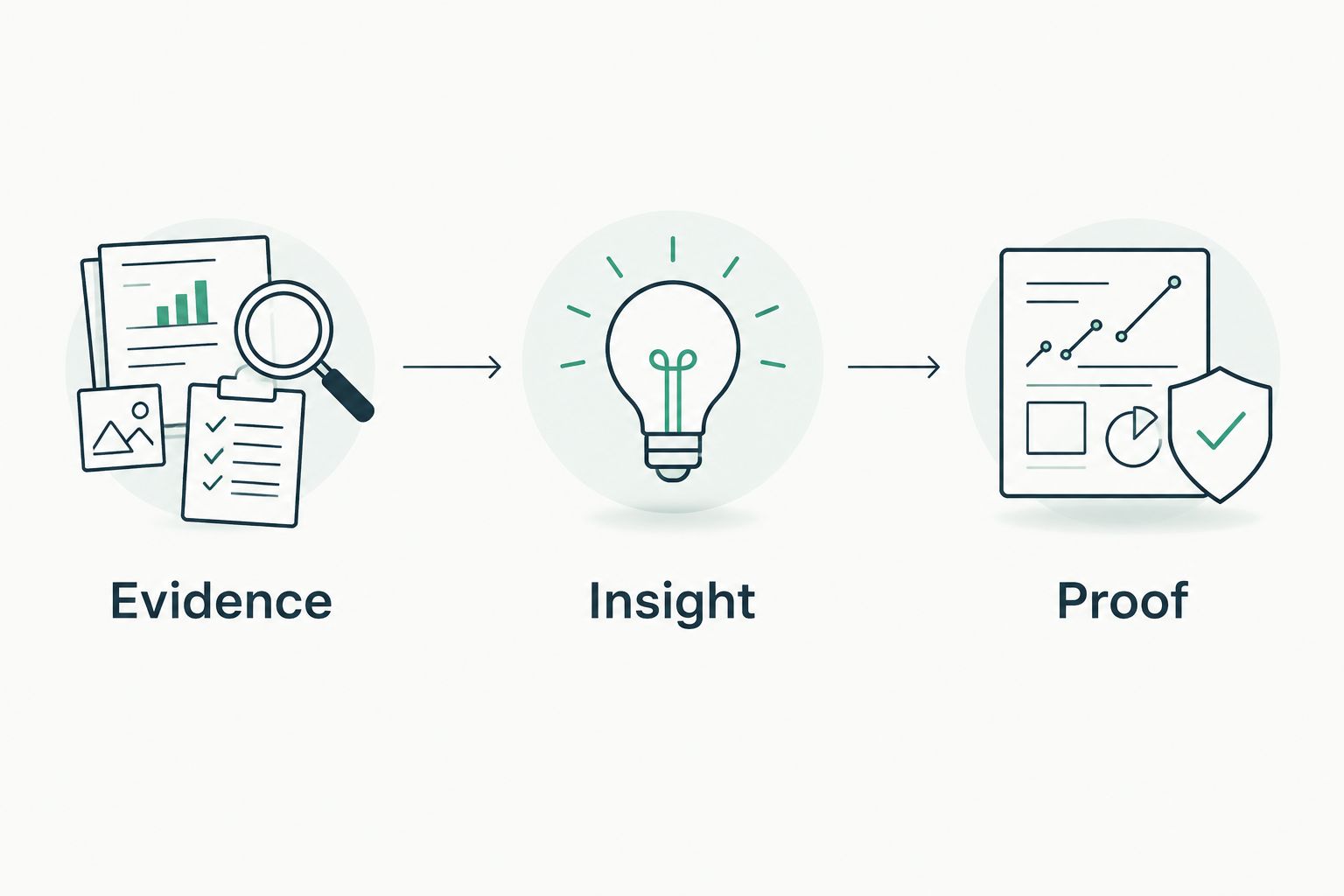
The evidence → insight → proof sequence prevents a technical signal from becoming an unsupported sales claim. Evidence is the observed condition. Insight explains the decision it raises. Proof is the additional information needed to confirm the interpretation or verify completed work.
For a 2026 email review, an observed DMARC policy can prompt a discussion about legitimate senders and the client's intended handling policy. It cannot support a claim that fraudulent invoices have been delivered. Ask about the business process rather than supplying an incident that never happened.
Close the translation step with these actions:
- State the observation without adding an incident narrative.
- Name the business process that needs clarification.
- Identify the person who can confirm the interpretation.
- Define the evidence needed to resolve the question.
- Remove unsupported breach, intent, and financial-loss claims.
The assessment record should make each transition visible. A finding earns a recommendation only when the reasoning and verification requirement are explicit.
Validate production dependencies separately
Begin with the client's system owners, existing diagrams, and approved procedures. Ask which business systems support production scheduling, maintenance coordination, remote support, and recovery. These are questions to investigate, not assumed features of every manufacturing environment.
A domain or Microsoft 365 review cannot substitute for examining operational technology. If production systems are included, agree on methods with the responsible owner and involve appropriate expertise. Do not apply office-network testing procedures to industrial equipment without an approved scope.
Document every dependency claim with its source. An interview establishes what an owner reports; a diagram establishes what that document shows. Neither independently proves that the deployed environment matches the account. Keep that distinction visible in the report.
Close the production-dependency review with these actions:
- Identify the owner of each production-supporting service.
- Ask how remote maintenance access is approved and removed.
- Separate documented architecture from verified configuration.
- Agree on testing methods before touching production systems.
- Refer out-of-scope industrial questions to an appropriate specialist.
Build an evidence-led proposal
Draft the proposal manually from confirmed scope and client decisions. Separate verified conditions, open questions, and work that still requires assessment. A proposal should not turn a prospecting observation into an established remediation requirement.
Recommend 1 next decision per finding to keep the proposal usable. That decision might be confirming a sender inventory, reviewing an access exception, or authorizing a deeper assessment. Do not attach a speculative loss figure to make the recommendation look urgent.
SCOUTz security posture assessment evidence supports proposal preparation; it does not replace the client's explanation of its environment. Retain the collection date and limits when transferring evidence into the proposal. In 2026, a dated observation still needs current validation before a change is approved.
Close the proposal step with these actions:
- Tie each proposed action to a stated observation or requirement.
- Identify what remains unknown before estimating remediation scope.
- Name the decision-maker and implementation owner.
- Define the evidence that will demonstrate completion.
- Separate further assessment from configuration changes.
Verify completed work and revisit the evidence
Start with a completion record, not a sales summary. Preserve the original observation, the authorized action, and the verification result. A task marked complete is not the same as evidence that the intended condition now exists.
For QBRs, revisit evidence according to the client's agreed review schedule and relevant changes. Do not present a previous snapshot as a current assessment. If you cannot reread a category, retain its prior date and describe the current state as unknown.
Use the 2026 review record to show what changed and what remains unanswered. That makes the QBR a decision meeting rather than a recycled findings presentation. Keep production-system conclusions within the same authorization and specialist boundaries used during the initial assessment.
Close the verification step with these actions:
- Record the authorized work and responsible owner.
- Capture verification evidence with its date and scope.
- Compare like-for-like observations where possible.
- Separate completed work from unverified completion claims.
- Assign an owner to each remaining question.
Compare assessment options for manufacturing clients
Choose the method by the question you need answered. Public-domain review, tenant review, and industrial assessment address different evidence boundaries. Combining their reports does not erase those boundaries.
| Option | Best for | Main advantage | Key limitation |
|---|---|---|---|
| Manual public-domain review | Preparing domain and email-security questions | Lets you inspect public records directly and document their source | Cannot establish tenant configuration or production-network conditions |
| Customer-authorized Microsoft 365 review | Assessing agreed identity and access categories | Examines tenant evidence within approved permissions | Unread categories remain unknown; factory controls are outside that scope |
| SCOUTz | MSP prospect intelligence and evidence-led sales preparation | Provides dated domain and Microsoft 365 security reviews | Is not a contact database, a replacement for MSP judgment, or a complete industrial assessment |
| Scoped operational technology assessment | Investigating production-system security questions | Addresses industrial systems within an agreed specialist scope | Requires separate authorization, methods, and production-owner involvement |
Choose complementary scopes, not a universal score. If the decision concerns email authentication, start with domain evidence. If it concerns tenant access, obtain authorization for tenant evidence. If it concerns production equipment, establish an industrial assessment scope.
Common mistakes MSPs make with manufacturing clients
Treating an email review as a factory assessment
A public-domain finding says nothing by itself about industrial network segmentation or machine access. Label the review accurately and list excluded systems. The manufacturing client should never need to discover the assessment boundary after reading the verdict.
Calling unread evidence clean
Missing permissions and unavailable records create unknowns. They do not create passing results. Keep unread evidence visible so the next authorized reviewer knows which questions remain open.
Turning a finding into a breach story
A configuration observation does not prove exploitation. It also does not establish dissatisfaction with the incumbent MSP or buying intent. Describe the finding, ask for context, and remove invented consequences from the proposal.
Ignoring the production owner's authority
An IT contact's approval does not automatically define acceptable work on production systems. Establish who authorizes industrial testing and changes. Keep collection and remediation separate until those responsibilities are settled.
Reusing stale evidence in a new proposal
A dated observation remains evidence of what was observed at that time. It is not proof of the current state. Recheck the relevant condition or state that its present status is unknown.
FAQ
What is a security posture assessment for manufacturing clients?
A security posture assessment for manufacturing clients reviews scoped cybersecurity evidence to identify decisions affecting business access and production continuity. MSPs should distinguish public-domain observations, authorized tenant evidence, and operational technology assessment.
Can an MSP assess a manufacturer using public-domain records alone?
Public-domain records support a limited domain and email-security review, not a complete manufacturing assessment. They do not establish Microsoft 365 configuration, production-network segmentation, or machine access controls.
What does a Microsoft 365 review tell an MSP?
A customer-authorized Microsoft 365 review provides evidence about the tenant categories included in its scope. The report should state the collection date, permissions, and unread categories without treating unknown evidence as clean.
Is SCOUTz a replacement for an operational technology assessment?
SCOUTz is not a replacement for an operational technology assessment. It provides dated domain and Microsoft 365 evidence for MSP prospect intelligence and sales preparation; industrial systems require their own authorized scope.
How should an MSP prioritize manufacturing security findings?
Prioritize findings by confirmed scope, the business process involved, and the next decision the client needs to make. Validate the interpretation before assigning remediation work, and do not invent breach costs or incidents.
What evidence belongs in a manufacturing security proposal?
A manufacturing security proposal should include the observation, source, collection date, scope, limits, and proposed verification. Separate confirmed conditions from open questions and work that requires further assessment.
How do MSPs prove that recommended work is complete?
MSPs prove completion by recording the authorized action and collecting verification evidence for the intended condition. A completed task or a previous snapshot alone does not establish the current security state.
One last thing
Make unknowns actionable. End the assessment with the unanswered question, the person who can answer it, and the evidence required. That is more useful than a confident score built from unread categories.
For MSP owners evaluating SCOUTz for evidence-led sales preparation, Join Open Beta is the next step. Keep the same standard in the sales conversation: show the dated evidence, explain its limits, and let verified context determine the recommendation.


