
Nonprofit-focused MSP prospect intelligence is dated research about an organization’s domain, email security, and authorized tenant configuration, with the aim of preparing a relevant sales conversation. This guide explains prospect intelligence for nonprofit clients in 2026: separate public evidence from permission-based reviews, connect findings to confirmed operational needs, and prepare a proposal without treating a security signal as buying intent.
- Prospect intelligence for nonprofit clients starts with dated evidence, not assumptions about budgets, breaches, or buying intent.
- SCOUTz provides MSP prospect intelligence through dated domain and Microsoft 365 reviews; MSP judgment remains essential.
- Public-domain evidence and customer-authorized Microsoft 365 evidence answer different questions. Keep their sources and limits separate.
- Connect email-security findings to confirmed nonprofit workflows before recommending work or writing a proposal.
Why prospect intelligence matters for nonprofit-focused MSPs
A nonprofit prospect needs a reason to discuss its operations, not a list of alarming technical observations. Start by asking which workflows matter: donor communications, volunteer coordination, service delivery, or another activity the organization identifies. Do not assume every nonprofit handles the same information or faces the same constraints.
SCOUTz is for MSPs that need dated domain and Microsoft 365 evidence for prospect conversations. The platform supplies evidence for preparation; it does not establish that a prospect wants to buy, has suffered a breach, or still has a previously observed problem.
For nonprofit outreach in 2026, the distinction matters. A public email-security observation supports a specific question. It does not establish the organization’s internal access controls, funding priorities, or readiness to replace its MSP.
Keep 2 evidence lanes separate: public-domain observations and customer-authorized tenant observations. Public research can support an introduction; tenant evidence requires authorization and a defined review scope.
Build an evidence-led nonprofit prospecting workflow
Define the nonprofit’s operating context
Start manually with the organization’s public website and published materials. Record what the organization says it does, who it serves, and which activities appear relevant to your services. Treat those descriptions as context, not a complete map of its technology.
Your first conversation should test that context. A fundraising page does not prove a particular donor-management system is in use. A volunteer application page does not reveal how volunteer accounts are managed. Ask who owns each workflow and what the organization wants to improve.
Use 3 context fields in your preparation notes: mission, workflow, and owner. Leave the owner unknown until a reliable source identifies that person or role. This prevents outreach from assigning technical responsibility to an executive merely because their name is public.
- Record the mission in the organization’s own terms.
- Identify a workflow relevant to the proposed conversation.
- Name the public source and the date you reviewed it.
- Mark unconfirmed systems and responsibilities as unknown.
- Prepare a question that tests your understanding of the workflow.
Collect public-domain evidence with clear boundaries
Begin with manual DNS lookups and public-domain checks. SPF records describe authorized sending sources, while DMARC records describe the domain’s published policy for messages that fail DMARC evaluation. Neither record gives you a complete view of the organization’s email operations.
For every observation, preserve the queried domain, check name, result, and observation date. Separate a missing published record from a failed lookup. A lookup that did not complete is unread evidence, not proof that a control is absent.
SCOUTz prospect intelligence provides dated domain reviews as a software-supported path alongside manual research. Apply the same boundaries to either method. A published policy is evidence about that policy at that time—not proof of a breach, successful impersonation, or an unresolved problem.
For a 2026 outreach list, review the evidence before sending the message rather than treating an earlier export as current.
- Record the exact domain examined.
- Preserve the check result rather than paraphrasing it into a stronger claim.
- Distinguish missing, unread, and observed evidence.
- Keep subdomain observations separate from organizational conclusions.
- Recheck the observation before using it in outreach.
Request authorized Microsoft 365 evidence
Public-domain research stops at the tenant boundary. It cannot establish which identities have privileged roles, how guests are configured, or which connected applications have consent. Those questions require customer-authorized evidence.
Start by agreeing on a read-only review scope with the organization. Establish who can authorize the review, which evidence you will access, who will receive the results, and how you will handle the resulting material. Read-only access still requires permission and careful handling.
SCOUTz provides customer-authorized Microsoft 365 reviews alongside public-domain reviews. Do not assume any particular check is covered without confirming the review’s scope. Evidence about identities, guest access, MFA, or application consent must be attributed to the actual source and collection date.
An unread setting stays unknown. No access is not a clean result.
- Confirm authorization before accessing tenant evidence.
- Define the read-only scope and intended use.
- Record the collection date and source.
- Identify settings or objects outside the review.
- Explain visibility gaps in the findings summary.
Translate evidence into a business question
A finding is a signal. The business question explains why the organization should discuss it. Keep that distinction visible in your notes and your meeting materials.
Use 1 discovery question per finding before recommending work. For a published DMARC observation, ask who manages the sending domain and which services send legitimate mail. For authorized guest-access evidence, ask how the organization manages external collaboration. Do not jump from either observation to a confirmed incident.
Apply an evidence → insight → proof structure. Evidence is the dated observation. Insight is the operational question it raises. Proof is the validation needed to support a conclusion or show that agreed work is complete.
The diagram below summarizes those three stages. Keep interpretation separate from what you actually observed.
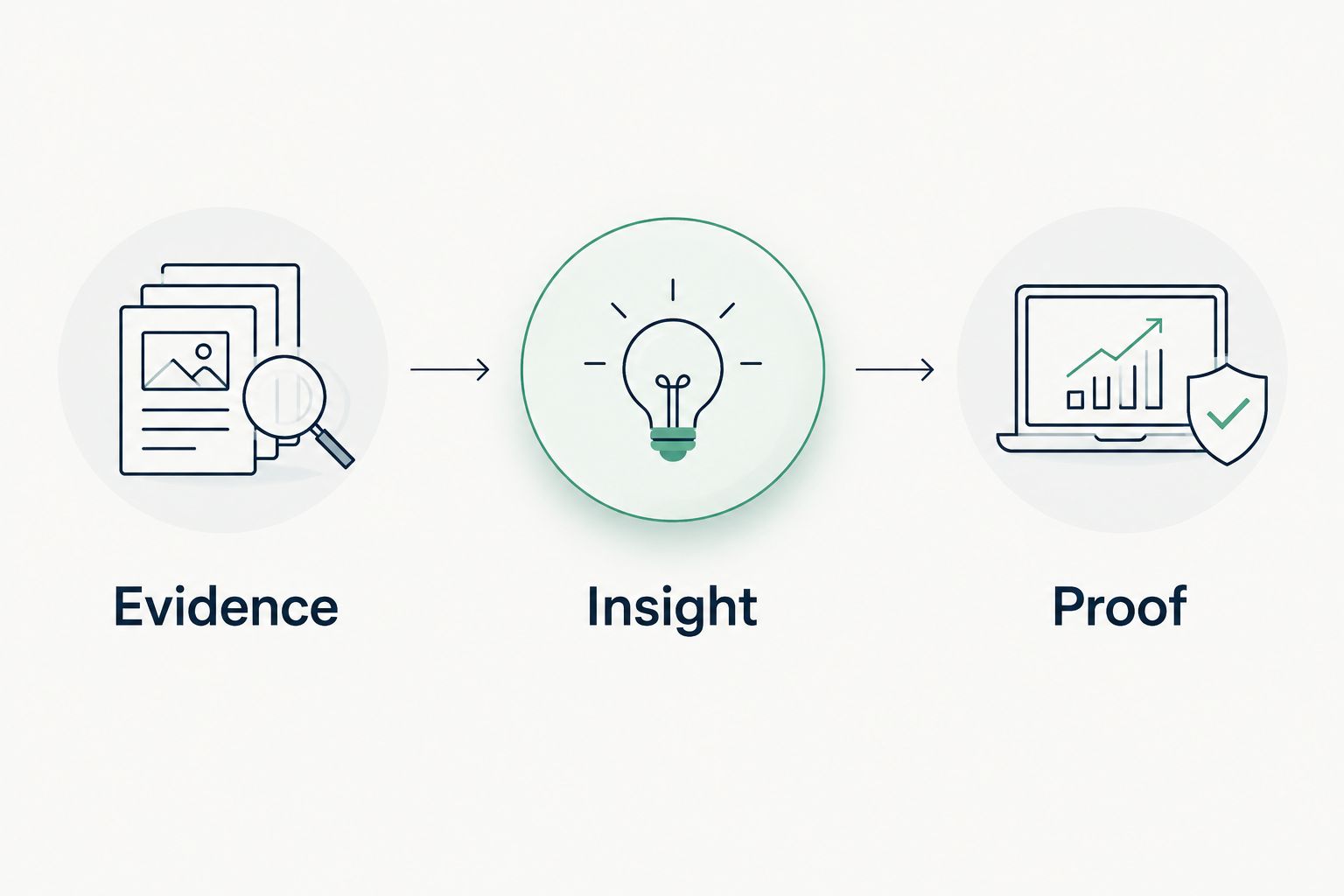
- Evidence: retain the source, date, result, and limits.
- Insight: name the workflow or responsibility to discuss.
- Proof: define how the interpretation will be validated.
- Separate proposed consequences from observed events.
- Remove unsupported breach claims and loss estimates.
Prepare outreach that earns a factual reply
Write the first message manually before turning it into a repeatable template. Use a relevant organizational fact, a bounded observation, and a question. Avoid combining unrelated findings into a security score that the recipient cannot interpret.
For nonprofit prospects, address the person whose responsibility is confirmed. When ownership is unknown, ask who manages the relevant service instead of implying that the recipient has failed to maintain it. A technical contact and a budget approver are not automatically the same person.
In 2026 outreach, identify when the evidence was observed and avoid calling it current unless you have checked it again. Give the recipient room to correct your understanding. A useful reply might establish ownership, explain an intentional configuration, or show that the observation is no longer relevant.
- State the organization-specific context without embellishment.
- Describe the observation and its scope in plain language.
- Include the observation date.
- Ask who owns the relevant workflow or configuration.
- Offer a conversation without implying an emergency.
Turn discovery into a bounded proposal
Start with a simple document that separates observed evidence, confirmed requirements, proposed work, and completion criteria. This is the manual path. Dated review evidence can support the document, but it does not decide the scope for you.
Ask how the nonprofit approves changes, who can authorize work, and which activities must remain uninterrupted. Where donor communications or volunteer collaboration are involved, confirm the dependencies before proposing a configuration change. Do not assume a tighter setting is an uncomplicated change.
Recommend work against a confirmed requirement, not against an alarming label. A published email policy can justify investigation; the agreed remediation depends on legitimate senders and operational constraints. An authorized tenant observation can justify review; its meaning depends on the organization’s intended access model.
- Attach the dated evidence supporting each proposed task.
- Record the requirement confirmed during discovery.
- Identify dependencies and approval owners.
- State what work is inside and outside scope.
- Define the evidence that will demonstrate completion.
Verify changes and prepare the next review
After authorized work, collect evidence again within the agreed scope. Compare like with like: the same domain, relevant setting, or defined set of objects. A different scope does not establish that the original condition changed.
For a 2026 QBR, show the earlier observation, the agreed action, and the new evidence separately. Explain what changed and what remains unknown. If a check was not repeated, do not label the associated work verified.
Keep sales preparation and service reporting distinct. Prospect research informs a conversation; a client review evaluates agreed work against evidence. Neither should turn limited visibility into a declaration that the organization is secure.
- Preserve the earlier evidence and its date.
- Record the authorized change or agreed decision.
- Repeat the relevant check within the defined scope.
- Explain differences in visibility or collection method.
- Mark unverified work and outstanding questions explicitly.
Compare nonprofit prospect intelligence options
Choose the method by the question you need to answer. Manual research is a reasonable starting point for a narrow public-domain question. A platform supports dated reviews, but it does not remove authorization requirements or replace technical interpretation.
| Option | Best for | Main advantage | Key limitation |
|---|---|---|---|
| Manual public-domain research | MSPs preparing a focused introduction | Lets you inspect public evidence directly | Does not reveal internal tenant configuration; documentation is your responsibility |
| SCOUTz | MSPs preparing evidence-led nonprofit conversations | Provides dated domain and Microsoft 365 reviews | Findings do not establish buying intent, a breach, or an unresolved problem |
| Customer-authorized Microsoft 365 review | MSPs answering defined tenant questions | Supports examination of evidence within an approved scope | Requires authorization; unread or excluded evidence remains unknown |
| Discovery interview and shared worksheet | MSPs confirming workflows, owners, and approvals | Establishes business context directly with the organization | Statements alone do not verify technical configuration |
These options complement each other. Public research establishes what is observable from outside. Discovery establishes context. Authorized review adds tenant evidence. Your judgment connects them without claiming more than the sources support.
Common mistakes nonprofit-focused MSPs make
Treating mission as a budget signal
A nonprofit’s mission does not establish its technology budget or procurement process. Ask how work is funded and approved. Do not build a proposal around assumptions drawn from the organization’s charitable status.
Turning donor-facing email into an incident claim
A domain finding does not prove that donor messages were intercepted, fundraising was disrupted, or anyone suffered a loss. Explain the observed configuration and ask about the sending workflow. Leave incident claims out unless verified evidence supports them.
Treating volunteer involvement as evidence of weak access
A volunteer program does not establish how accounts, guests, or offboarding are managed. Ask how external participation works. Use authorized evidence to assess the relevant configuration rather than treating the operating model itself as a finding.
Sending tenant details to the wrong stakeholder
Permission to review evidence does not automatically authorize unrestricted distribution. Agree on recipients before sharing results. An owner-facing summary should explain decisions and limits without exposing unnecessary identity or access details.
Carrying old findings into a new proposal
An observation is dated evidence, not a permanent property of the prospect. Recheck it before using it to justify new work. If you cannot verify its current state, say that the state is unknown.
FAQ
What is prospect intelligence for nonprofit clients?
Prospect intelligence for nonprofit clients is dated research used to prepare an MSP sales conversation. It combines organizational context with bounded public-domain evidence and, when authorized, Microsoft 365 evidence.
What should an MSP check before contacting a nonprofit?
An MSP should confirm the nonprofit’s public operating context and document any relevant public-domain observation. Record the source, date, and limits, then prepare a question rather than assuming a problem or buying intent.
Can public-domain checks reveal a nonprofit’s Microsoft 365 security settings?
Public-domain checks do not establish internal Microsoft 365 security settings. Tenant questions require customer-authorized evidence within a defined review scope.
Does a missing DMARC record prove that a nonprofit has been breached?
A missing DMARC record does not prove a breach. It is a domain-policy observation that requires context, a reliable lookup, and an observation date.
Is SCOUTz a replacement for an MSP’s judgment?
SCOUTz is not a replacement for MSP judgment. It provides dated cybersecurity evidence and prospect intelligence through domain and Microsoft 365 reviews; the MSP must interpret scope, confirm requirements, and recommend work.
How should an MSP discuss security findings with a nonprofit board?
An MSP should connect verified findings to confirmed workflows, proposed decisions, and completion evidence. Keep technical limits explicit and omit speculative breach losses or unsupported incident claims.
What belongs in a nonprofit security proposal in 2026?
A nonprofit security proposal in 2026 should include dated evidence, confirmed requirements, defined work, approval owners, and completion criteria. Separate unknown settings from observed conditions and do not present unread evidence as clean.
One last thing
Ask what would disprove your interpretation before you send the message. An intentional configuration, a different sending service, or a corrected ownership assumption can change the recommendation. That is useful discovery, not a failed pitch.
Make Join Open Beta your next step with SCOUTz. Bring a defined prospect-review question and keep the evidence boundaries intact: public observations first, authorized tenant evidence where agreed, and proof before a conclusion.


