
Property management domain security scanning is a review of public domain and email-security evidence with the aim of helping MSPs prepare relevant, evidence-led sales conversations. Separate what you can observe externally from customer-authorized Microsoft 365 evidence, and connect each observation to a workflow the prospect confirms.
- Domain security scanning for property management clients starts with verified domains, dated observations, and explicit limits.
- SCOUTz is best for MSPs preparing evidence-led prospect conversations, not building contact lists.
- Public DNS evidence does not establish Microsoft 365 MFA coverage, a breach, or buying intent.
- Use email-security reviews to frame questions about payment instructions, tenant communications, and vendor workflows.
Why domain security scanning matters for property management clients
A domain finding becomes useful when you can explain its scope and ask a relevant business question. For property management prospects, ask which domains support resident messages, owner reporting, vendor correspondence, and payment instructions. Do not assume that the website domain represents every communication channel.
Your 2026 review should distinguish evidence, insight, and proof. Evidence is the dated observation. Insight is its bounded interpretation. Proof requires verification appropriate to the claim: DNS evidence can prove a published record existed at collection time, but not that every message passed authentication.
SCOUTz provides dated cybersecurity evidence and prospect intelligence for MSP sales preparation. SCOUTz is best for MSPs preparing evidence-led prospect conversations. It is not a contact database or a substitute for your judgment.
A useful opening is a question about an observed configuration and a confirmed workflow. A finding alone is not a reason to imply urgency. Neither an unread setting nor an unanswered question establishes an unresolved problem.
How to run an evidence-led domain review
Start manually. Verify the prospect's domain, inspect public records, and record what you actually observed. Introduce software after you have defined the review boundary, not as a prerequisite for understanding the evidence.
Verify the prospect's domain boundaries
Start with the organization's published website and ask the prospect to confirm domain ownership before making account-level conclusions. A property name, management-company name, and resident-facing portal can refer to different organizations. Similar names do not establish common ownership or responsibility.
Build a domain map that separates confirmed relationships from assumptions. Ask whether a portal belongs to the management company or an outside provider. Record who controls DNS, who operates email, and which business process uses each domain. Those responsibilities need confirmation; a public scan cannot assign them reliably.
For a 2026 prospect review, keep the initial scope narrow enough to explain clearly. A focused review of a confirmed business domain is more useful than a large list of loosely associated domains.
- Record the exact domain and its published source.
- Label ownership as confirmed or unconfirmed.
- Separate management-company domains from property-specific domains.
- Identify third-party portals without treating them as prospect-owned assets.
- Ask who approves changes to DNS and email configuration.
Capture public email-security evidence
Use manual DNS lookups to inspect MX, SPF, and DMARC records. Record the queried name, returned record, collection date, and lookup result. Preserve failures as failures rather than translating them into a clean result.
MX records identify published mail routing. SPF describes authorized sending infrastructure for a domain. DMARC publishes policy and reporting instructions tied to authentication and alignment. None of these records proves that every sending service is configured correctly or that someone monitors reports.
DKIM requires special care. A lookup needs a selector; checking a guessed selector does not establish whether the domain uses DKIM. Obtain selectors from authorized message headers or customer-provided configuration before making a broader statement. Public evidence also does not reveal tenant-wide MFA coverage.
- Preserve the raw DNS response alongside your interpretation.
- Record the observation date and time zone.
- Distinguish a missing record from an unsuccessful lookup.
- Identify the specific name and selector you checked.
- State which conclusions require message samples or tenant access.
Organize findings into reviewable evidence
Start with a spreadsheet or document. Give each observation a source, date, scope, interpretation, and next verification question. Keep the original result close to the summary so another practitioner can check your reasoning without reconstructing the review.
SCOUTz provides a software path for dated domain and Microsoft 365 evidence used in MSP prospect intelligence. Use it for sales preparation while retaining the same evidence discipline. The platform's role does not remove the need to confirm ownership, authorization, business relevance, and current status.
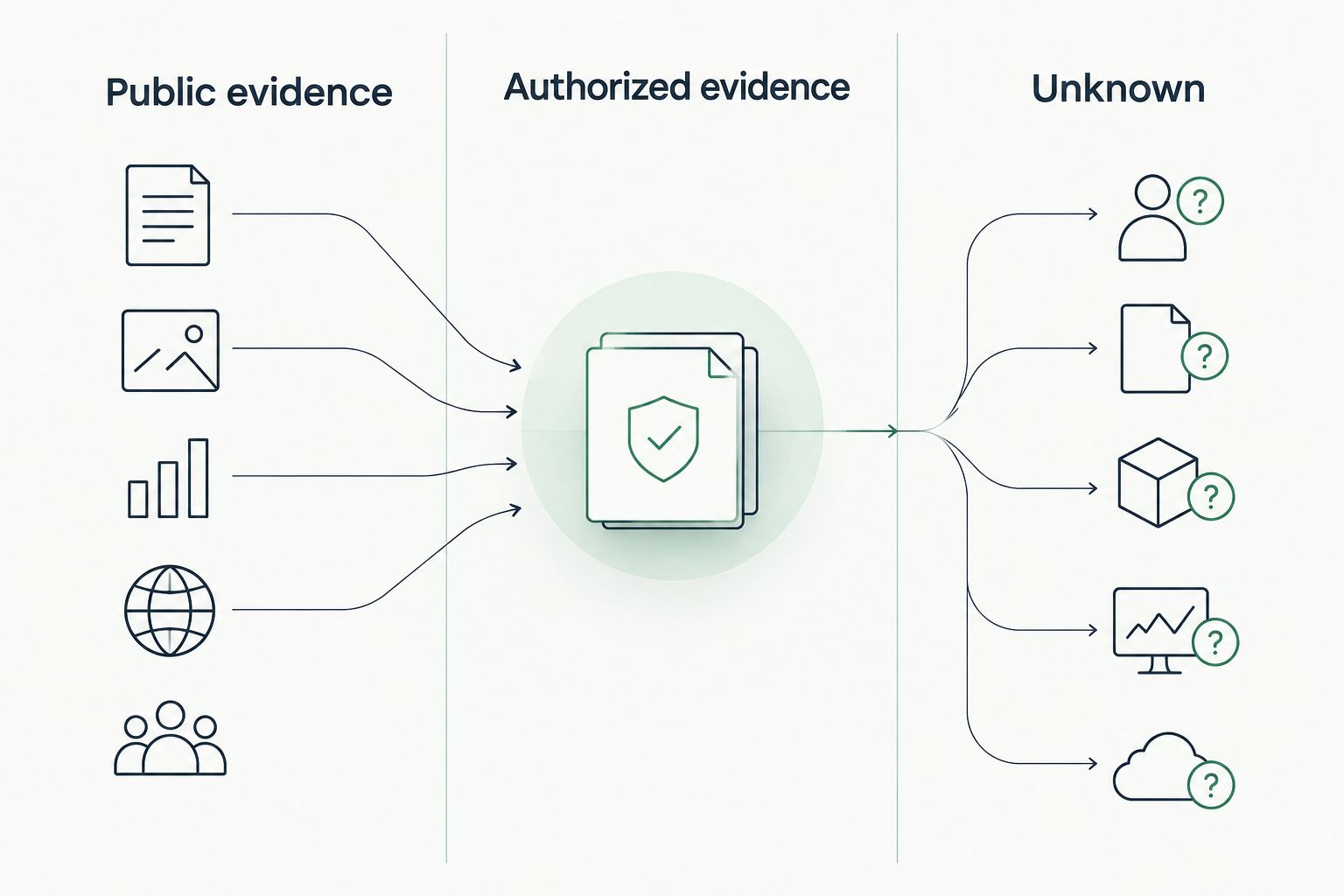
For your 2026 review, separate these labels in the working document: Public evidence, Authorized evidence, and Unknown. Unknown is a valid result. It prevents a public-domain review from appearing to cover settings that nobody inspected.
- Keep the source and observation together.
- Separate observed facts from interpretations.
- Mark evidence that was not collected as unknown.
- Attach the question needed to resolve each uncertainty.
- Review summaries before using them in outreach.
Connect observations to confirmed workflows
Ask the prospect how communication works before assigning a consequence. Determine whether staff send owner reports, whether residents receive automated notices, and whether vendors exchange payment instructions by email. These are discovery questions, not facts established by domain scanning.
Then connect the observation to the confirmed process. A published DMARC policy is evidence about domain policy. It is not evidence that a fraudulent payment occurred. An unfamiliar sending service is a reason to confirm ownership and purpose, not a reason to call the service malicious.
Use a simple progression: show the observation, explain its boundary, and ask what the organization expects. That keeps the conversation specific without treating every technical finding as a sales opportunity. The prospect's answer determines whether further review is relevant.
- Ask which messages carry payment-related instructions.
- Confirm which systems send resident and owner communications.
- Identify who approves new email-sending services.
- Ask how staff verify changed vendor payment details.
- Record the prospect's explanation separately from scan evidence.
Request authorization for Microsoft 365 review
Public-domain review and Microsoft 365 assessment are different scopes. Public DNS does not establish the tenant's identity controls, guest-account practices, or application consent configuration. Do not describe those areas as assessed until authorized evidence has been collected.
Start with a documented scope and customer-authorized read-only access. Identify what the review will inspect, what it will exclude, and who can approve access. Describe the access actually granted rather than using read-only as a blanket claim about every possible permission.
A 2026 Microsoft 365 review should record the tenant context and collection date. When a query fails or an area falls outside authorization, retain that limit in the report. Read-only review produces observations; it does not itself remediate settings or establish that an incident occurred.
- Confirm the authorized tenant and approving contact.
- Document permissions and the agreed review scope.
- Separate identity, guest, and application evidence by source.
- Mark inaccessible or unread settings as unknown.
- Agree how findings will be verified before proposed changes.
Write an evidence-led proposal
Build the proposal manually from the evidence register. For each proposed task, state the observation, its business relevance, the verification needed, and the work that follows if the concern is confirmed. This prevents a prospecting signal from becoming an unsupported remediation claim.
Use language that matches the evidence. A DNS lookup can support a statement about the record returned at that time. It cannot support a statement that attackers accessed accounts, that the organization lost money, or that the prospect intends to buy.
Separate assessment work from corrective work. Where ownership, sender inventory, or configuration intent remains unknown, propose verification first. For property management prospects, make responsibilities explicit when the management company, property owner, and outside provider control different parts of a workflow.
- Cite the source and date beside each observation.
- Name the workflow the prospect confirmed.
- State the evidence limit before the proposed action.
- Assign verification and change-approval responsibilities.
- Define the evidence that will demonstrate completed work.
Recheck evidence before outreach and QBRs
Re-run relevant checks before presenting a finding as current. Domain records and tenant settings are changeable. A dated result remains evidence of its collection point, not a guarantee of the present configuration.
For a 2026 proposal or quarterly business review, show the original observation beside the new observation. Explain whether the same scope and method were used. A changed result needs interpretation; it does not automatically prove that the underlying workflow is now secure.
Close the loop with verified work. If a configuration was changed, capture the authorized change record and the follow-up check that supports the stated outcome. If the prospect has not confirmed whether anything changed, say that status is unknown. Do not carry an old finding forward as unresolved by default.
- Recheck findings used in current outreach.
- Preserve original dates instead of overwriting them.
- Compare equivalent scopes and collection methods.
- Record verified changes separately from recommendations.
- Carry unanswered questions into the next review explicitly.
Compare review options for your MSP
Choose the method according to the evidence you need. Manual review offers direct control over individual checks. Software supports an organized prospect-review workflow. Customer-authorized tenant review answers questions that public evidence cannot answer. None replaces the others across every scope.
| Option | Best for | Strength | Key limitation |
|---|---|---|---|
| Manual public-domain review | MSPs checking a confirmed prospect domain | Direct inspection of DNS records with explicit lookup context | Requires manual documentation and does not expose tenant settings |
| SCOUTz prospect intelligence | MSPs preparing evidence-led sales conversations | Provides dated domain and Microsoft 365 review evidence | Does not replace MSP judgment or establish buying intent |
| Customer-authorized Microsoft 365 review | MSPs examining agreed tenant configuration | Supports conclusions about the authorized settings actually inspected | Requires authorization and remains limited by permissions and collection scope |
Start with public evidence; request tenant access only for questions that require it. Do not position authorization as a condition for an initial conversation. Explain the question first, then the additional access needed to answer it.
For MSPs ready to explore the platform, Join Open Beta is the next step. Keep the same source, date, and scope standards when evaluating software-supported reviews.
Common mistakes in property management prospect reviews
Treating every property domain as a managed asset
A property-branded website or portal does not prove the management company controls its domain or email. Confirm the responsible organization before recommending work. Otherwise, your proposal assigns remediation to someone who has not been shown to control the configuration.
Confusing email policy with payment-fraud evidence
A DMARC observation concerns published email policy. It does not prove that someone diverted rent, altered vendor instructions, or accessed an account. Ask about the relevant process without presenting a hypothetical event as an observed incident.
Calling a domain review a tenant assessment
Public records cannot establish Microsoft 365 MFA coverage or application consent settings. Label the review by its actual scope. If tenant evidence was not collected, those areas remain unknown rather than passing or failing an implied assessment.
Ignoring third-party senders and portals
An automated resident notice or owner report can involve a separate provider. Ask which systems send messages and who controls their configuration. Do not recommend DNS changes until the authorized sender inventory and business requirements are understood.
Reusing findings without checking their status
An older observation is not proof of an unresolved problem. Recheck the configuration and ask about completed work before repeating the claim. Keep the original result for comparison, but separate historical evidence from current status in outreach and proposals.
FAQ
What is domain security scanning for property management clients?
Domain security scanning for property management clients is a scoped review of public domain and email-security evidence. MSPs use the observations to prepare questions about confirmed business workflows, not to assert a breach or buying intent.
What should an MSP check before contacting a property management prospect?
An MSP should verify the business domain and record dated public DNS observations with their limits. Confirm ownership and workflow relevance before assigning responsibility or recommending changes.
Can a domain scan tell me whether Microsoft 365 MFA is enabled?
A public-domain scan cannot establish Microsoft 365 MFA coverage. That conclusion requires customer-authorized tenant evidence covering the relevant settings and scope.
Does a missing DMARC record prove the company was breached?
A missing DMARC record does not prove a breach. A successful lookup supports a statement about the record observed at collection time, not a statement about incident history.
Is SCOUTz a contact database for property management prospecting?
SCOUTz is a SaaS platform for dated cybersecurity evidence and prospect intelligence, not a contact database. It supports MSP sales preparation through domain and Microsoft 365 reviews without replacing MSP judgment.
Should I recommend configuration changes from public evidence alone?
Recommend verification before changes when ownership, intended configuration, or sending services remain unknown. Public evidence can support a scoped observation, but corrective work needs confirmed responsibility and requirements.
How should I use domain findings in a property management proposal?
Use domain findings as dated observations with a stated scope, business question, and verification step. Separate assessment from remediation, and define the evidence needed to demonstrate completed work.
One last thing
Check the ownership boundary before expanding the technical review. The most detailed finding is not useful if the prospect does not control the affected configuration.
Start your next review with a confirmed business domain and a workflow question. Preserve what you observed, explain what remains unknown, and let the prospect confirm relevance. That is the difference between showing a security signal and establishing a reason to continue the conversation.


