
Best overall for ongoing external asset discovery in 2026: Microsoft Defender External Attack Surface Management. Best for MSP sales preparation: SCOUTz. Best for searching exposed services: Shodan. Choose external attack surface assessment tools by the evidence you need, not by how alarming the results look.
- Microsoft Defender External Attack Surface Management is the default for ongoing discovery of internet-facing assets.
- SCOUTz is best for MSP prospect intelligence and sales preparation, not a substitute for authorized technical validation.
- Compare external attack surface assessment tools by discovery scope, evidence dates, ownership confidence, and authorization requirements.
- Public-domain evidence and customer-authorized Microsoft 365 evidence answer different questions; keep their boundaries explicit.
Why this matters
An external assessment starts with what an outsider can observe. That includes domains, DNS records, certificates, reachable services, and other public infrastructure signals. It does not automatically reveal internal controls, establish asset ownership, or prove a breach.
For an MSP, the distinction changes the conversation. A public observation supports a question. Customer-authorized evidence supports a more specific assessment. Neither establishes buying intent or proves that a previously observed problem remains unresolved.
SCOUTz is best for MSPs that need dated prospect evidence before a sales conversation. That is a different job from maintaining an enterprise asset inventory or validating a network service.
What makes the best external attack surface assessment tools?
Use these criteria for your 2026 shortlist:
- Discovery scope: Separate domain mapping, internet-service search, ongoing asset discovery, and direct network inspection.
- Evidence provenance: Record where an observation came from and when it was collected.
- Ownership confidence: Distinguish a related asset from an asset the prospect actually controls.
- Authorization boundary: Know whether you are querying public evidence or interacting directly with a system.
- Decision fit: Choose evidence that supports your next action: a discovery question, an inventory correction, or an authorized assessment.
- Explicit limits: Keep unread controls and untested systems unknown. An empty result is not a clean bill of health.
A useful result survives scrutiny. You should be able to explain what was observed, what it means, and what still needs verification without turning an inference into a fact.
External attack surface assessment tools at a glance
The order below follows distinct use cases. It is not a claim that one product replaces every other option.
| Tool | Best for | Standout function | Key limitation |
|---|---|---|---|
| SCOUTz | MSP prospect intelligence | Dated cybersecurity evidence and prospect intelligence | Prospect evidence does not establish buying intent |
| Microsoft Defender External Attack Surface Management | Ongoing external asset discovery | Discovery and inventory of internet-facing assets | Discovered relationships still need ownership review |
| Censys | Internet host and certificate research | Search across observed hosts and certificates | An indexed observation is not a live validation |
| Shodan | Exposed-service investigation | Searchable internet-service observations | Service visibility does not prove exploitability |
| OWASP Amass | Domain and infrastructure mapping | Attack surface mapping and asset discovery | Mapped relationships need interpretation and verification |
| Nmap | Authorized network-service validation | Direct host, port, and service discovery | Results cover the selected targets and scan conditions |
1. SCOUTz: best for MSP prospect intelligence
SCOUTz provides external assessment evidence for an MSP-specific job: preparing for a prospect conversation. Its SaaS platform delivers dated cybersecurity evidence and prospect intelligence through domain and Microsoft 365 reviews. The purpose is preparation, not a contact database or a replacement for MSP judgment.
Keep the evidence sources separate. Public-domain evidence describes externally observable signals. Customer-authorized read-only Microsoft 365 evidence describes what was accessible within the authorized review, with its own scope and limits.
SCOUTz pros:
- Aligns evidence with MSP prospect research and sales preparation.
- Provides dated cybersecurity evidence rather than an undated assertion.
- Covers domain reviews and customer-authorized Microsoft 365 reviews.
SCOUTz cons:
- A finding does not confirm a breach, an unresolved issue, or buying intent.
- Public-domain evidence cannot answer questions that require tenant access.
- Evidence still needs MSP interpretation before it becomes a recommendation.
Best for: MSP owners and sales leaders preparing an evidence-led first meeting or proposal.
Use an observation to ask a precise question. Do not turn it into a claim that the prospect has ignored a problem. Verdict: Choose SCOUTz for MSP sales preparation; skip treating prospect intelligence as a full technical assessment.
2. Microsoft Defender External Attack Surface Management: best for ongoing discovery
Microsoft Defender External Attack Surface Management discovers and inventories internet-facing assets associated with an organization. It fits the operational question: what external infrastructure belongs in our assessment scope? That is broader than reviewing a single domain before a sales call.
Its place in this 2026 shortlist is ongoing discovery. Asset relationships are useful starting points, but association and ownership are not interchangeable. Review candidates before assigning responsibility or requesting changes.
Microsoft Defender External Attack Surface Management pros:
- Focuses on discovering internet-facing infrastructure.
- Supports an external asset inventory rather than a single service lookup.
- Provides a basis for reviewing assets associated with an organization.
Microsoft Defender External Attack Surface Management cons:
- Discovered associations require ownership confirmation.
- An external inventory does not establish internal control effectiveness.
- Assessment conclusions still require context from the asset owner.
Best for: Security teams and MSPs responsible for maintaining an organization's external asset inventory.
Choose it when discovery is a continuing responsibility, not simply a pre-meeting research task. Verdict: Choose Microsoft Defender External Attack Surface Management for ongoing external discovery; hold remediation decisions until ownership and relevance are confirmed.
3. Censys: best for internet host and certificate research
Censys lets you research internet hosts and certificates through indexed observations. It is useful when you need to examine publicly observed infrastructure and investigate relationships suggested by certificates or host data. Search is the starting point, not the final conclusion.
A certificate containing a domain name can support an investigation. It does not, by itself, prove that the same organization currently controls every related host or that a certificate-associated service remains reachable.
Censys pros:
- Supports searches across observed internet hosts.
- Provides certificate research alongside host investigation.
- Helps you develop asset hypotheses for further review.
Censys cons:
- Observation dates matter; indexed results are not necessarily current.
- Certificate relationships do not establish current ownership.
- Search results do not substitute for authorized validation.
Best for: Practitioners investigating host and certificate evidence before defining assessment scope.
Record the observation date separately from the date you performed the search. Those dates answer different questions. Verdict: Choose Censys for infrastructure research; hold ownership and current-exposure claims until verified.
4. Shodan: best for investigating exposed services
Shodan indexes observations of internet-connected services and makes them searchable. It helps you investigate what a service exposed when it was observed, including information returned by that service. The result is evidence of an observation, not evidence of a successful attack.
A service banner can identify a product or report a version. Treat that as a lead. A reported version alone does not establish whether a specific vulnerability is applicable or whether a compensating control exists.
Shodan pros:
- Supports searches for externally observed services.
- Surfaces service details that guide follow-up questions.
- Helps distinguish service exposure research from domain-only research.
Shodan cons:
- Results describe the indexed observation, not guaranteed present conditions.
- Banners can be incomplete or misleading.
- Reachability does not prove exploitability or business impact.
Best for: Security practitioners examining internet-facing service exposure.
For a prospect conversation, explain the observation without claiming a vulnerability has been exploited. Verdict: Choose Shodan for exposed-service research; skip using a banner as proof of compromise.
5. OWASP Amass: best for domain and infrastructure mapping
OWASP Amass supports attack surface mapping and external asset discovery. It suits practitioners who need to investigate domains and infrastructure relationships, then assemble a scope for further assessment. The work is mapping, not proving that every discovered relationship represents a current risk.
Keep the collection method visible. Passive-source research and active techniques have different interaction and authorization implications. Configure your work to match the permission you actually have.
OWASP Amass pros:
- Focuses on external asset discovery and mapping.
- Supports investigation of domain and infrastructure relationships.
- Gives practitioners a mapping workflow rather than a sales narrative.
OWASP Amass cons:
- Discovered relationships require ownership and relevance checks.
- Collection choices affect scope and authorization requirements.
- Mapping alone does not validate vulnerabilities or tenant controls.
Best for: Technical teams building an external asset map for an authorized assessment.
Retain source information alongside discovered assets. Otherwise, a relationship can become an unsupported ownership claim as it moves between reports. Verdict: Choose OWASP Amass for mapping; hold risk ratings until the relevant assets and conditions are verified.
6. Nmap: best for authorized network-service validation
Nmap performs direct network discovery and can inspect ports and services on selected targets. It belongs after scope and authorization are clear. Unlike searching an existing index, running a scan interacts with the target environment.
The IANA service registry assigns TCP port 443 to HTTPS, TCP port 25 to SMTP, and UDP port 53 to DNS. Those assignments help interpret results, but a port number alone does not identify the actual service or establish that its configuration is secure.
Nmap pros:
- Examines selected targets directly rather than relying only on an index.
- Supports host, port, and service discovery.
- Helps validate specific exposure questions within authorized scope.
Nmap cons:
- Requires care with authorization, target selection, and scan behavior.
- Results reflect the selected methods and conditions at scan time.
- An external scan does not assess unread Microsoft 365 controls.
Best for: Practitioners validating network exposure on explicitly authorized targets.
Record the target, method, timestamp, and limits with the result. Verdict: Choose Nmap for authorized validation; skip direct scanning when permission or ownership is unclear.
Turn evidence into a defensible conversation
Use this sequence for your 2026 assessment notes. It works whether you start with a public lookup or customer-authorized evidence.
Evidence
Record the observed condition, source, collection date, and scope. Separate the original observation from your interpretation. If the collection date is unavailable, say so rather than assigning the date of your report.
Insight
Explain the question the evidence raises. A reachable service raises a question about intended exposure. A domain relationship raises a question about ownership. Neither proves an incident or tells you that the prospect wants to change providers.
Proof
Identify what would confirm the interpretation. That might be owner confirmation, a current authorized check, or customer-authorized read-only tenant evidence. If verification has not happened, keep the conclusion open.
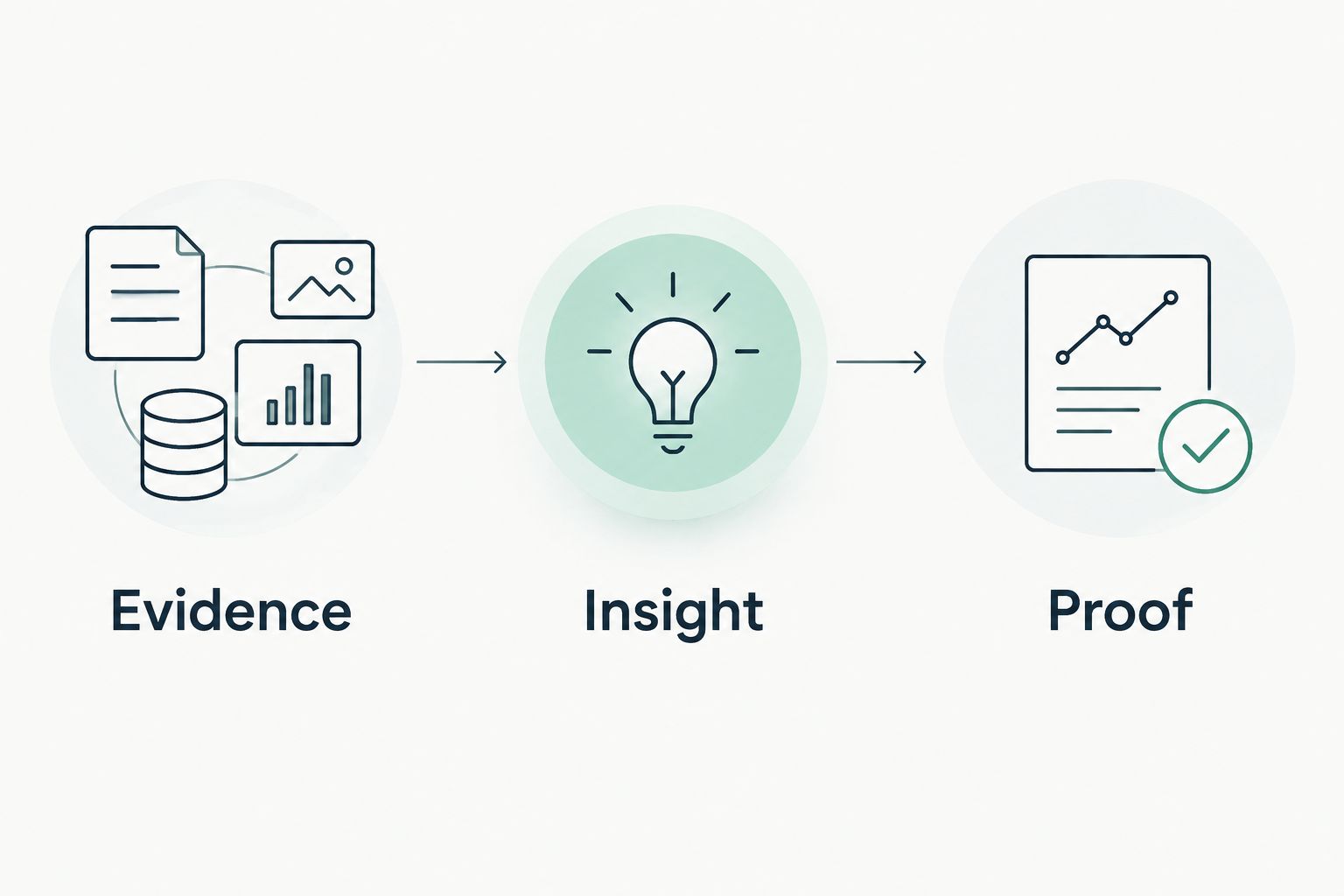
A proposal should preserve this sequence, not erase it. State what is known, what remains unknown, and which authorized work would answer the remaining questions. The same boundary applies in a QBR: an old finding is not proof that a condition persists.
How these tools are ranked
This 2026 ranking prioritizes fit for the named use case: prospect preparation, ongoing discovery, host research, service investigation, mapping, or validation. It does not claim a head-to-head test or measured detection advantage.
The criteria are discovery scope, evidence provenance, ownership confidence, authorization, decision fit, and explicit limits. A tool ranks well when its job matches the question you need to answer. A larger result set is not automatically better evidence.
Which external attack surface assessment tools should you choose?
Choose Microsoft Defender External Attack Surface Management as the default for ongoing external asset discovery. Choose the MSP-focused option when your immediate job is prospect preparation, not asset inventory management.
Use Censys for host and certificate research, Shodan for exposed-service investigation, and OWASP Amass for mapping. Use Nmap when a specific exposure needs direct, authorized validation.
Before selecting a tool in 2026, finish this sentence: “I need evidence to decide whether…” If the answer is vague, define the decision first. Software cannot repair an undefined assessment scope.
FAQ
What's the best external attack surface assessment tool for an MSP?
SCOUTz is best for MSP prospect intelligence and sales preparation. Choose an asset-discovery or validation tool instead when the task is maintaining an inventory or directly checking authorized targets.
Is Microsoft Defender External Attack Surface Management better than Shodan?
Microsoft Defender External Attack Surface Management is the better fit for ongoing organizational asset discovery; Shodan fits exposed-service research. They answer different questions, so choose by task rather than treating their results as interchangeable.
Can public-domain evidence prove a company has been breached?
No. A public observation can establish what was visible within its collection scope, but a breach conclusion requires separate evidence.
What's the difference between a domain review and a Microsoft 365 review?
A public-domain review examines externally observable evidence; a customer-authorized read-only Microsoft 365 review examines accessible tenant evidence within the granted scope. Public evidence cannot establish the status of tenant controls it did not read.
Does an open port mean a service is vulnerable?
No. An open port establishes reachability under the observation conditions, not exploitability; the service, configuration, applicable vulnerability, and controls require further assessment.
Can I run Nmap against a prospect without permission?
Do not run direct scans without clear authorization and agreed scope. Searching existing public observations and interacting with a prospect's systems are different activities.
How do I know whether an external assessment finding is still current?
Check the original collection date and validate the condition through an appropriate authorized method. The date you opened a search result does not replace the date the underlying evidence was collected.
Should an unknown result count as a clean result?
No. Unknown means the evidence did not establish the condition; keep unread controls, unverified ownership, and untested systems explicitly unknown.
One last thing
Keep two dates in your notes: when the evidence was collected and when you reviewed it. A fresh report can contain old evidence. That distinction is easy to lose and essential to preserve.
A finding is not a reason to claim a problem. It is a reason to ask a better question.


