
Best overall for MSP-focused dark web monitoring: Dark Web ID. Best for identity-exposure investigations: SpyCloud. Best for broader threat-exposure research: Flare. Best for a known-breach baseline: Have I Been Pwned. This 2026 guide separates monitoring from breach notifications, prospect intelligence, and proof of an active security problem.
- Dark Web ID is the default shortlist choice for MSP-focused dark web monitoring.
- SpyCloud fits identity-exposure investigations; Flare fits broader threat-exposure research.
- Have I Been Pwned supplies known-breach evidence, not a complete dark web monitoring service.
- SCOUTz supports MSP prospect intelligence, not a substitute for dark web monitoring tools for MSPs.
Why this matters
An exposed email address is a signal. It is not proof that a password still works, an account has been accessed, or a prospect needs to replace its MSP.
Your tool choice determines what evidence you receive. Your review determines what you can responsibly say about it. Those are different jobs.
SCOUTz is best for MSP prospect intelligence and sales preparation using dated domain and Microsoft 365 evidence. That is a separate category from dark web monitoring. Keep those boundaries intact when building a 2026 sales or security workflow.
What makes the best dark web monitoring tools for MSPs?
Use these criteria before comparing vendors. A long findings list does not compensate for unclear sources or an alert nobody owns.
- Evidence provenance: Can you identify where the record came from and distinguish a breach record from another exposure source?
- Date clarity: Can you separate the reported exposure date from the date your service observed or reported it?
- MSP workflow: Does the current offering support how you separate customers, assign work, and report findings?
- Identity context: Can your analyst connect an exposed identifier to an authorized customer account without assuming the credentials remain valid?
- Response ownership: Can you turn a finding into a documented review, assigned action, and verification step?
- Coverage limits: Can you explain what the service observes, what it cannot establish, and what remains unknown?
Rank by the work you need to perform, not by the most alarming sample report. Check the current product documentation and contract against these criteria before choosing a service.
Dark web monitoring tools for MSPs at a glance
These 2026 recommendations are use-case matches, not measured detection-rate rankings. The table distinguishes dedicated monitoring from a narrower breach-checking resource.
| Tool | Best for | Standout role | Key limitation |
|---|---|---|---|
| Dark Web ID | MSP-focused managed monitoring | Dark web credential-exposure monitoring aimed at MSP use | An exposure finding does not establish active account compromise |
| SpyCloud | Identity-exposure investigations | Recovered exposure data used in account-takeover prevention workflows | Exposed identity data still needs account and remediation context |
| Flare | Broader threat-exposure research | Threat-exposure monitoring across sources beyond breach notifications | Broader findings require analysis before becoming customer actions |
| Have I Been Pwned | Known-breach baseline checks | Searchable breach records and domain breach notifications | It is not a complete dark web monitoring service |
1. Dark Web ID: best dark web monitoring for MSP delivery
Dark Web ID, from ID Agent, is the default shortlist choice when your main requirement is an MSP-oriented credential-exposure monitoring service. Its category fit is direct: monitoring exposure and bringing that evidence into a managed service workflow.
Start the evaluation with a customer scenario, not a dashboard tour. Ask the vendor to demonstrate how a finding moves from identification to customer review and assigned follow-up. Assess the current offering against your actual delivery process.
Dark Web ID pros
- Direct alignment with MSP dark web monitoring requirements.
- Credential-exposure evidence provides a concrete starting point for identity review.
- A focused monitoring category keeps the evaluation tied to a defined service outcome.
Dark Web ID cons
- A reported credential exposure does not prove that the credential remains usable.
- Monitoring evidence alone does not establish the customer's current identity-control configuration.
Best for: MSPs selecting a dedicated dark web monitoring component for a managed security service.
Evidence: A record associates an identifier with an exposure source. Insight: The associated identity deserves review within the authorized customer environment. Proof: Your team verifies relevant controls and documents the response; the alert itself does not supply that proof.
Before including a finding in a customer report, preserve the source description and date. If the available record does not support a claim about a password or account, leave that claim out.
Verdict: Buy for MSP-focused monitoring after confirming the current customer-management and response workflow.
2. SpyCloud: best for identity-exposure investigations
SpyCloud focuses on recovered exposure data and its use in preventing account takeover. It belongs on your shortlist when the central question is identity exposure rather than simply whether a domain appears in a breach notification.
The useful distinction is investigative purpose. You need evidence that helps your team assess exposed identities and decide what to verify in the customer's environment. You do not need another unsupported declaration that a customer has been breached.
SpyCloud pros
- Clear alignment with account-takeover prevention work.
- Exposure data supports investigations centered on identities and credentials.
- Fits an evidence-led review where analysts connect external records to authorized internal checks.
SpyCloud cons
- Recovered exposure data does not establish the current state of an account.
- Identity-focused investigations do not replace a broader customer security assessment.
Best for: MSP security teams with a defined identity-exposure investigation and remediation process.
Ask for a demonstration using a representative investigation. Can your reviewer explain the record's provenance? Can the team distinguish an exposed identity from evidence of current unauthorized access? Can the resulting customer action be stated without overstating the finding?
In your 2026 evaluation, treat those questions as acceptance criteria. A richer record is useful only when your team can interpret it and act within the customer's authorization.
Keep historical exposure and current verification separate in the report. A past record remains historical evidence even after your team checks the account today.
Verdict: Buy for identity-exposure investigations when your team owns the verification and response work.
3. Flare: best for broader threat-exposure research
Flare is a threat-exposure monitoring platform. Its role is broader than checking known breach records, making it a shortlist option when your analysts need to investigate external exposure across different source types.
That broader scope changes the buying decision. You are selecting an investigation workflow, not merely adding a breach-notification feed. Require the demonstration to show how an analyst moves from a source record to a defensible customer finding.
Flare pros
- Broader threat-exposure focus than a breach-checking resource.
- Supports research that starts with external exposure evidence.
- Fits teams that need to investigate context before recommending customer action.
Flare cons
- An external reference to an organization does not prove that the organization is compromised.
- Broader research requires interpretation; a collected record is not automatically an actionable customer issue.
Best for: MSP security teams responsible for broader external threat-exposure research.
Give the evaluator a reporting task: explain what was observed, why it matters, and what remains unverified. The output should survive review by both a practitioner and a customer owner.
A mention, listing, or record can justify investigation. It cannot establish buying intent, the quality of the incumbent provider, or an unresolved security problem without additional evidence.
For a 2026 service evaluation, define who reviews findings before they reach customers. If your intended workflow stops at forwarding alerts, first resolve the ownership gap. Broader source coverage does not resolve it for you.
Verdict: Buy for analyst-led threat-exposure research; hold if no one owns interpretation and follow-up.
4. Have I Been Pwned: best for a known-breach baseline
Have I Been Pwned lets users check identifiers against its breach data and provides domain-related breach notification capabilities with domain verification. It is useful for establishing a known-breach baseline.
It is not a like-for-like replacement for a dedicated dark web monitoring service. The important boundary is its dataset: a result describes inclusion in the breach records available to the service, not every possible exposure.
Have I Been Pwned pros
- A clear starting point for checking known breach exposure.
- Named breach context helps explain where an identifier appeared.
- Domain verification provides an authorization boundary for domain-level use.
Have I Been Pwned cons
- A negative result does not establish that an identity has never been exposed.
- A breach match does not show whether the associated account is currently compromised.
Best for: MSPs that need a known-breach reference alongside a wider assessment process.
Use the result as evidence of dataset inclusion. Then verify the relevant account state and controls through an authorized process. Do not test exposed credentials against a prospect's systems.
If you use programmatic access, review the current access terms and requirements before designing a customer workflow. A useful reference service and a managed monitoring operation are different things.
Keep the explanation simple: the service has a matching breach record, or it does not. Neither result answers every question about the customer's present security.
Verdict: Hold as a complementary baseline; skip as your sole dark web monitoring service.
Turn exposure evidence into a defensible customer action
Use a short evidence-to-action record instead of copying an alert directly into a proposal. Preserve 3 evidence fields: source, observation date, and scope. Those fields explain what your team actually knows.
Separate 2 dates whenever the record supplies them: the reported exposure date and your observation date. Never replace an unknown exposure date with the date you checked the service.
Assign 1 response owner to the next action. Ownership is a workflow requirement, not proof that the finding is severe.
Evidence
State what the record contains and where it came from. Distinguish an email-address match from a credential record, and distinguish both from tenant evidence. If a field is unread or unavailable, label it unknown.
Insight
Explain the supported consequence. An exposed identity calls for review of that identity and relevant controls. It does not establish successful access, a current incident, or a reason to displace the existing provider.
Proof
Document what an authorized reviewer verified and what action followed. If verification has not happened, the status remains unverified. Do not mark a finding resolved merely because it has been acknowledged.
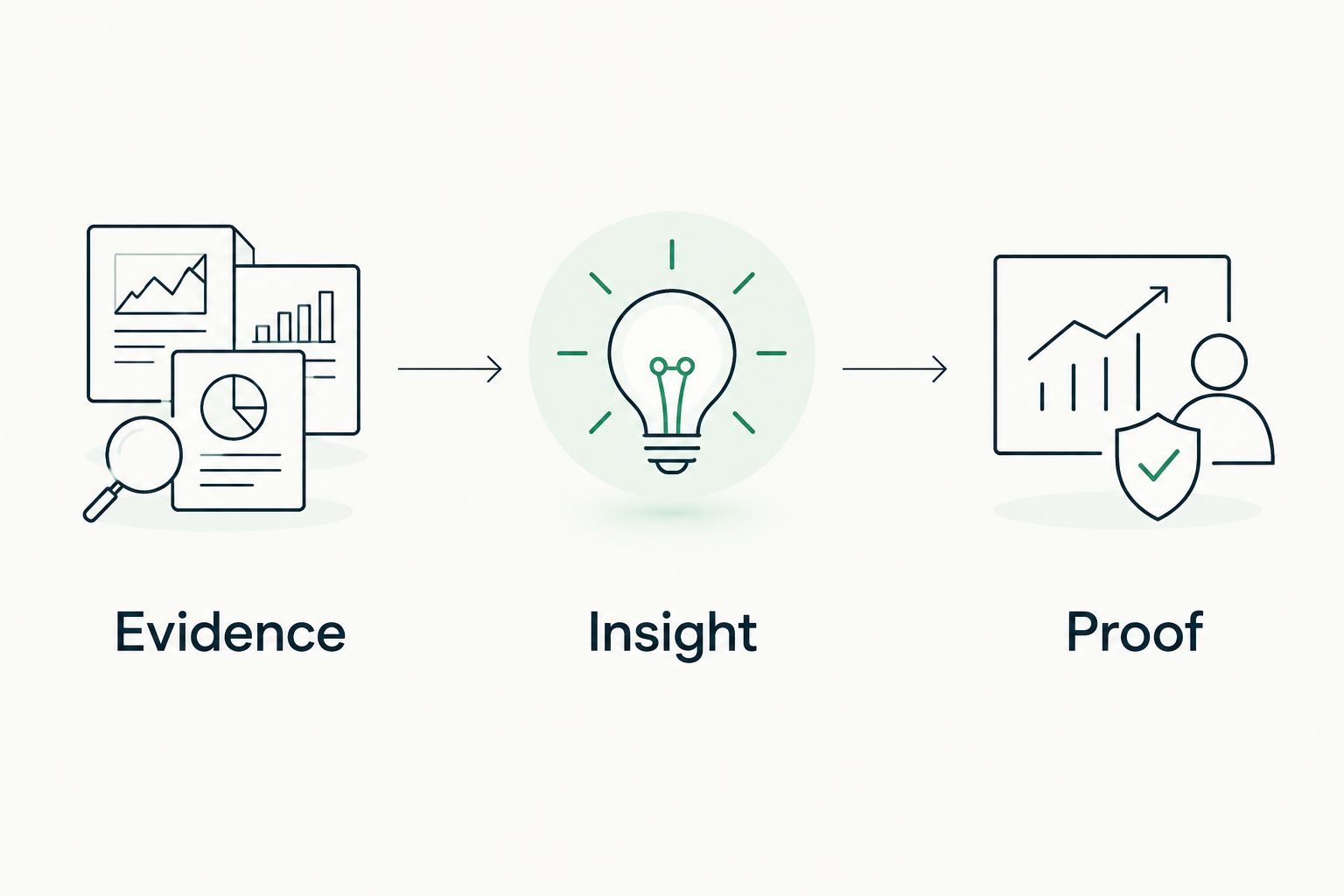
This structure works for customer reports and sales preparation because it keeps the statement smaller than the evidence. You can discuss a real observation without claiming a breach that has not been established.
Where SCOUTz belongs in the stack
SCOUTz supports MSP prospect intelligence and sales preparation through dated domain and Microsoft 365 reviews. Do not evaluate SCOUTz as a dark web monitoring replacement.
Public-domain evidence and customer-authorized read-only Microsoft 365 evidence have different boundaries. Public observations describe what was visible within the review's scope. Authorized tenant evidence describes what was readable within the approved Microsoft 365 scope.
Neither category grants permission to infer unread settings, successful compromise, or purchasing intent. For sales preparation, state the source and date, explain the business question, and ask for permission to verify further.
Best for: MSP owners and sales leaders preparing evidence-led prospect conversations. Strength: Dated evidence grounds the conversation. Limitation: Prospect intelligence does not replace monitoring or MSP judgment.
If that is your requirement, the next step is Join Open Beta, rather than treating a monitoring alert as a finished sales argument.
How we ranked these tools
The order reflects category fit and distinct work: MSP monitoring, identity investigation, broader exposure research, then known-breach reference checks. It does not claim a comparative detection test or guaranteed coverage.
The criteria remain the same across every option: provenance, dates, customer workflow, identity context, response ownership, and explicit limits. Confirm current capabilities during your 2026 evaluation before making a commitment.
Which dark web monitoring tool should you choose?
Choose Dark Web ID as the default shortlist entry for MSP-focused monitoring. Choose SpyCloud when identity-exposure investigations drive the requirement, and Flare when broader threat-exposure research does.
Use Have I Been Pwned as a known-breach reference, not as proof of complete coverage. Keep SCOUTz in the separate prospect-intelligence and sales-preparation role.
Before buying, ask the vendor to demonstrate a complete finding-to-action workflow. If the demonstration cannot distinguish observed evidence from verified outcome, the evaluation is not finished.
FAQ
What's the best dark web monitoring tool for MSPs in 2026?
Dark Web ID is the default shortlist choice for MSP-focused dark web monitoring. Choose SpyCloud for identity-exposure investigations or Flare for broader threat-exposure research, then confirm the current workflow against your requirements.
Is Have I Been Pwned a dark web monitoring replacement?
No. Have I Been Pwned provides known-breach checks and domain breach notifications, not a complete dark web monitoring service. A negative result does not establish that an identity has never been exposed.
Does an exposed password prove a customer has been breached?
No. An exposed credential record does not establish that the credential still works or that someone successfully accessed the customer's account. Verify current account conditions through an authorized process.
Is SpyCloud better than Flare for an MSP?
SpyCloud is the shortlist fit for identity-exposure investigations; Flare is the shortlist fit for broader threat-exposure research. Select by the work your team owns rather than treating the platforms as interchangeable.
Can I test a prospect's exposed credentials?
Do not attempt to authenticate to a prospect's systems without explicit authorization. Preserve the evidence, state its limits, and request permission for an appropriate review.
Does SCOUTz replace dark web monitoring?
No. SCOUTz provides dated cybersecurity evidence and prospect intelligence through domain and Microsoft 365 reviews. Use it for MSP sales preparation, not as a substitute for exposure monitoring.
What should an MSP include in an exposure report?
Include the source, observation date, scope, supported interpretation, and verification status. Separate the reported exposure date from your observation date, and keep unknown evidence explicitly unknown.
One last thing
No matching record is not the same as no exposure. That distinction belongs in your report template, not just in an analyst's head.
For every 2026 review, preserve the search scope and observation date alongside the result. The next reviewer needs to know what you checked, not merely that the page showed nothing.


