
Best for evidence-led prospect preparation: SCOUTz. Best for Microsoft-focused control assessments: Microsoft Purview Compliance Manager. Best for audit-readiness workflows: Vanta. Best for continuous control monitoring: Drata. Best for custom control mapping: a structured spreadsheet. The right compliance gap analysis tools for MSPs in 2026 depend on whether you need a reason to ask questions, a control assessment, or an ongoing evidence workflow.
- SCOUTz fits MSP prospect intelligence and sales preparation, not a complete compliance assessment.
- Microsoft Purview Compliance Manager fits Microsoft-focused assessments; verify evidence beyond the tenant separately.
- Vanta fits audit-readiness workflows; Drata fits continuous control monitoring.
- Choose compliance gap analysis tools for MSPs by evidence coverage, framework scope, and ownership.
- Keep unknown evidence unknown. A finding does not prove a breach, buying intent, or an unresolved problem.
Why this matters
A compliance gap is a difference between an applicable requirement and the evidence supporting it. A security finding is an observation. Those are not interchangeable.
For an MSP evaluating tools in 2026, the distinction changes the proposal. A public email-security observation can support a discovery question. It does not establish that a prospect fails a particular compliance requirement or needs remediation today.
SCOUTz is best for MSPs preparing evidence-led sales conversations, not issuing compliance conclusions. Its role belongs before the complete assessment: dated cybersecurity evidence and prospect intelligence from domain and Microsoft 365 reviews.
Choose the assessment workflow after you establish the client's obligations, scope, and authority to inspect evidence. Otherwise, a polished report can present assumptions as facts.
What makes the best compliance gap analysis tools for MSPs
Use these 5 selection criteria before comparing products:
- Evidence provenance: Each finding needs a source, collection date, scope, and limitation. A screenshot without context is not a complete evidence record.
- Requirement mapping: The workflow must connect an observation to an applicable requirement, rather than treating every security recommendation as a compliance obligation.
- Authorization boundaries: Public-domain evidence and customer-authorized tenant evidence must remain distinguishable. Access to one does not authorize access to the other.
- Remediation ownership: Each accepted gap needs an accountable owner, an agreed action, and a way to record verification. Reporting alone does not close it.
- MSP operating fit: Evaluate client separation, access control, reporting, evidence export, and handoff requirements against your delivery model. Confirm capabilities before committing.
Treat these as acceptance criteria, not feature-count targets. A product with more checks still fails your process if nobody can explain what a finding means.
Compliance gap analysis tools at a glance
| Option | Best for | Standout role | Key limitation |
|---|---|---|---|
| SCOUTz | Evidence-led prospect preparation | Dated domain and Microsoft 365 security evidence for MSP conversations | Prospect evidence does not establish complete compliance coverage |
| Microsoft Purview Compliance Manager | Microsoft-focused control assessments | Assessments, improvement actions, and compliance-management workflows | Microsoft evidence does not establish every organizational control |
| Vanta | Audit-readiness workflows | Coordinating controls and evidence for compliance programs | Evidence collection still requires scope decisions and review |
| Drata | Continuous control monitoring | Monitoring controls and maintaining compliance evidence | Monitoring cannot establish every procedural or organizational requirement |
| Structured spreadsheet | Custom control mapping | Explicit requirement-to-evidence records under your own process | Collection, review, updates, and verification depend on manual discipline |
The table ranks workflow fit, not measured performance. None of these options removes the need for MSP judgment, client participation, or a properly scoped assessment.
1. SCOUTz: best for evidence-led prospect preparation
SCOUTz provides a SaaS platform for dated cybersecurity evidence and prospect intelligence, including domain and Microsoft 365 reviews. For an MSP, its relevant role is preparing the conversation before a complete compliance assessment exists.
Separate public-domain observations from customer-authorized, read-only Microsoft 365 evidence. Public records describe what was observable outside the organization. Tenant evidence describes what an authorized review could read within its stated scope.
SCOUTz pros:
- Fits prospect/security intelligence and MSP sales preparation.
- Provides dated evidence for conversations rather than unsupported claims about a prospect.
- Covers domain and Microsoft 365 review contexts while preserving the distinction between them.
SCOUTz cons:
- Dated technical observations do not prove organization-wide compliance.
- Prospect intelligence does not establish buying intent or confirm an unresolved problem.
- Tenant conclusions remain bounded by authorization, readable evidence, and review scope.
Best for: MSP owners and sales leaders who need defensible questions before proposing an assessment.
A useful handoff follows evidence, insight, then proof. Record the observation first. Explain the question it raises second. Ask the customer to validate the current state before presenting an action as necessary.
Verdict: Buy for prospect preparation; skip as a substitute for a complete compliance assessment.
2. Microsoft Purview Compliance Manager: best for Microsoft-focused assessments
Microsoft Purview Compliance Manager organizes compliance assessments and improvement actions within Microsoft's compliance-management environment. It fits an MSP assessment centered on Microsoft services and the controls surrounding them.
Keep the boundary visible. A Microsoft-focused assessment still needs evidence for requirements that sit outside the tenant, such as documented procedures, physical safeguards, and supplier oversight.
Microsoft Purview Compliance Manager pros:
- Provides a structured assessment and improvement-action workflow.
- Gives Microsoft-focused assessments a place to organize requirements and supporting evidence.
- Supports conversations about control implementation rather than isolated configuration observations.
Microsoft Purview Compliance Manager cons:
- A compliance score is not a certification or a complete compliance conclusion.
- Non-Microsoft systems and organizational procedures need separate evidence.
- Assessment scope and shared responsibilities still require interpretation.
Best for: MSPs assessing Microsoft-centered environments with defined requirements and authorized access.
For a 2026 evaluation, inspect how the assessment represents customer responsibilities. Do not assume a platform-managed safeguard proves the customer's corresponding process works.
Verdict: Buy for Microsoft-focused assessments; hold if your main evidence sits outside that environment.
3. Vanta: best for audit-readiness workflows
Vanta supports compliance programs through control and evidence workflows. Its relevant role here is organizing the work that connects requirements, supporting records, and audit preparation.
Choose this category when your client needs a maintained compliance program, not merely a point-in-time list of technical findings. Confirm the required frameworks, evidence sources, and delivery workflow during evaluation.
Vanta pros:
- Provides a compliance-oriented place to organize controls and evidence.
- Supports a repeatable audit-readiness workflow rather than disconnected files.
- Helps structure the work needed to maintain supporting records.
Vanta cons:
- Collected evidence still needs review for relevance, completeness, and scope.
- Organizational controls require participation from the client's responsible teams.
- Your MSP must confirm how client access, evidence handoff, and reporting fit its operating model.
Best for: MSP engagements where the client needs organized evidence and coordinated audit preparation.
Ask the client to explain the purpose of the program before selecting templates. A framework is useful only when its scope matches the obligations and assurance needs of the organization.
Verdict: Buy for audit-readiness coordination; skip if the engagement only needs a narrow discovery review.
4. Drata: best for continuous control monitoring
Drata supports compliance programs with continuous control monitoring and evidence management. Its relevant use case is maintaining visibility after an initial assessment, rather than treating the gap report as the end of the engagement.
Continuous monitoring describes a workflow, not universal coverage. Your assessment still needs a defined scope and a clear distinction between automatically observed controls and controls requiring human review.
Drata pros:
- Supports ongoing monitoring rather than relying only on periodic evidence gathering.
- Connects control status and supporting evidence within a compliance workflow.
- Fits engagements that need recurring review after initial assessment work.
Drata cons:
- Connected systems do not cover every organizational requirement.
- Monitoring results need interpretation before they become accepted gaps.
- Policies, process execution, and exceptions still require accountable review.
Best for: MSPs supporting an ongoing compliance program with connected evidence sources and recurring control review.
During a 2026 pilot, follow a finding through its full lifecycle. Check how your team records context, assigns responsibility, reviews the change, and retains proof of the final state.
Verdict: Buy for ongoing control monitoring; hold until evidence coverage and review responsibilities are clear.
5. Structured spreadsheet: best for custom control mapping
A structured spreadsheet can hold requirements, evidence references, assessment decisions, owners, and verification records. It suits a tightly scoped engagement where your MSP needs direct control over the assessment structure.
Its strength is transparency. Its weakness is that the file does not collect evidence, inspect systems, or maintain itself.
Structured spreadsheet pros:
- Makes the requirement-to-evidence relationship explicit.
- Allows a tailored scope without implying unsupported product capabilities.
- Keeps assessment decisions visible to reviewers who understand the control set.
Structured spreadsheet cons:
- Evidence collection and status maintenance are manual.
- Copies, permissions, and version history need a controlled process.
- Consistency depends on the assessor and the quality of the review method.
Best for: MSPs conducting a bounded assessment with custom requirements and a named reviewer.
Give each requirement its own record. Include applicability, evidence source, collection date, evidence limits, assessment decision, responsible owner, and verification reference. Keep raw evidence in an appropriately controlled location rather than scattering attachments across copies.
Verdict: Buy into the method for a bounded assessment; skip an unmanaged spreadsheet as an ongoing compliance program.
Turn evidence into a defensible gap decision
Use this sequence regardless of which platform you select. The tool stores or gathers information; the assessment establishes what that information supports.
Evidence
Record what you observed, where it came from, and when you collected it. Distinguish public-domain records from customer-authorized read-only tenant evidence. Preserve unread evidence as unknown.
For example, an observed DMARC record describes a published email-authentication policy at the collection time. It does not prove how every message is handled or establish organization-wide compliance.
Insight
Connect the observation to a specific question and an applicable requirement. State the consequence within the evidence boundary, without inventing a breach, financial loss, or customer intention.
Ask whether the observation reflects an approved design, an exception, a changed state, or something the customer has already addressed. A finding is not automatically an unresolved problem.
Proof
Validate the assessment decision with the authorized customer owner. If a gap is accepted, define the action and the evidence that will verify completion. Retain the dated result rather than changing a status without support.
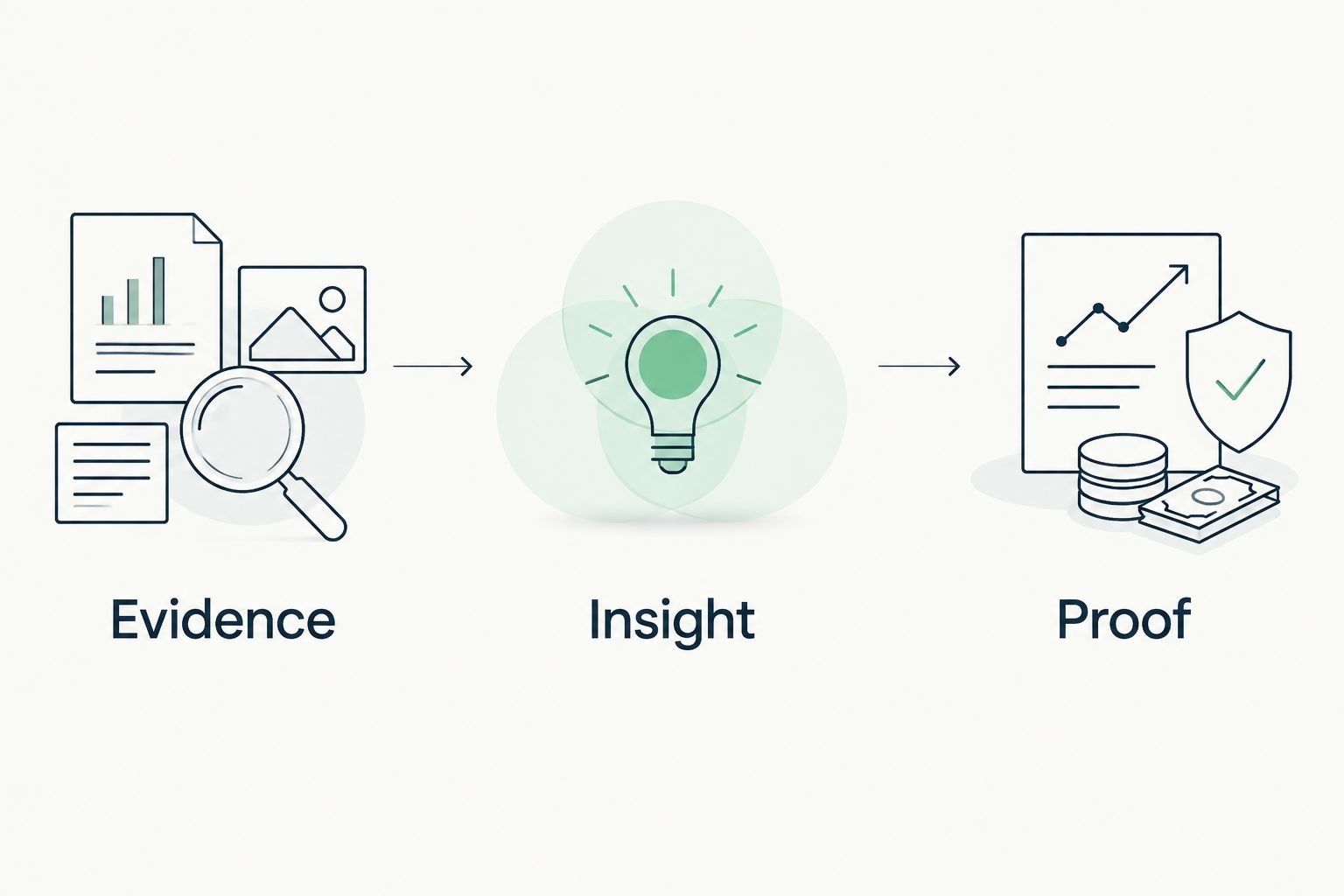
Use 3 evidence states during triage: observed, unknown, and not applicable. These describe evidence coverage, not the final compliance decision. Unknown must never silently become compliant.
How the options are ranked
This 2026 guide assigns each option a distinct job: prospect preparation, Microsoft-focused assessment, audit-readiness coordination, continuous monitoring, or custom mapping. The selection criteria are evidence provenance, requirement mapping, authorization boundaries, remediation ownership, and MSP operating fit.
The ranking does not claim comparative test results. Evaluate your shortlist against a real assessment scope before choosing a platform.
Which compliance gap analysis tool should you choose?
Choose Microsoft Purview Compliance Manager for a Microsoft-focused assessment; choose Vanta or Drata when the requirement is a maintained compliance workflow. Use a structured spreadsheet when a bounded, custom assessment needs transparent mapping more than automation.
For pre-assessment sales preparation, choose the prospect-evidence workflow instead. Do not buy a compliance platform merely to produce a reason to contact a prospect.
Start your 2026 evaluation with 1 authorized client tenant and a defined assessment scope. Trace an observation to its source, requirement, reviewer decision, assigned action, and verification evidence. Reject workflows that lose those connections.
FAQ
What's the best compliance gap analysis tool for an MSP?
The best tool depends on the assessment scope. Microsoft Purview Compliance Manager fits Microsoft-focused assessments, Vanta fits audit-readiness workflows, and Drata fits continuous control monitoring.
Is SCOUTz a replacement for a compliance assessment platform?
No. SCOUTz provides dated cybersecurity evidence and prospect intelligence for MSP preparation; a complete compliance assessment also needs applicable requirements, broader evidence, and validated decisions.
Can public-domain evidence prove that a prospect is noncompliant?
Public-domain evidence alone does not establish organization-wide noncompliance. Record the source, collection date, and limits, then validate applicability and current context with the customer.
Does a Microsoft 365 review prove that a company is compliant?
No. A Microsoft 365 review covers the authorized, readable tenant evidence within its scope, not every organizational system, policy, or procedure.
Can an MSP use a spreadsheet for compliance gap analysis?
Yes, a structured spreadsheet can support a bounded assessment. It needs controlled evidence references, explicit decisions, responsible owners, and a maintained review process.
What should an MSP do when evidence cannot be read?
Mark unread evidence as unknown. Record the access or scope limitation and identify what authorized evidence would be needed to make a decision.
How should an MSP verify that a compliance gap is closed?
Verify closure against the accepted requirement and agreed completion evidence. Retain the dated result and reviewer decision rather than relying only on a changed status.
One last thing
A finding is not a reason to call; a supported consequence is a reason to ask a better question. Before using a finding in a proposal, ask the customer whether it is current, applicable, and already addressed.
Next step: Join Open Beta. Use SCOUTz for evidence-led MSP prospect preparation, then keep assessment conclusions inside the scope your customer has authorized.


